Section 5.3 · Further exercises · 4 of 4
Exercise 5.3.4: Linear motor on rails
About the further exercises of Section 5.3
Four further exercises on Faraday's law, in the spirit of Problems 5.3.1–5.3.2 and the home exercises, graded from easy to harder. They use only the equations listed at the head of this subsection.
Linear motor on rails
#A bar of mass and length rests on frictionless rails in a uniform field perpendicular to the rails. The rails are fed by a source through a total resistance . (a) Find the initial current, force and acceleration. (b) Write the equation of motion and find the terminal velocity. (c) Find the time constant and the current at terminal velocity. (d) Where does the energy go at terminal velocity?
Adapted from: B. M. Notaroš, Electromagnetics, Problem 6.20.
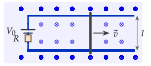
Home exercise 5.3.2 run backwards. The source drives a current, the current feels , and as soon as the bar moves its motional emf opposes the source. Newton's law plus the loop equation give a first-order linear equation for .
At rest there is no motional emf: , , . The force pushes the bar along the rails, away from the source (check with the right-hand rule for the sense of in the figure).
Once the bar moves with velocity it generates the back-emf , which opposes (Lenz), so the loop equation and Newton's law read
The acceleration vanishes when :
The equation is linear, with
At terminal velocity the back-emf cancels exactly, so (for frictionless rails).
With the source delivers no power and nothing is dissipated: the bar coasts. With friction or a load force the bar settles at , the source supplies , of which is mechanical power and is heat, the power balance of every DC motor.
Units: is , and since and , the result is seconds. The same appears as emf in the generator of Home exercise 5.3.2 and as back-emf here, and is also the stopping time of the released generator bar.
cf. Home exercise 5.3.2