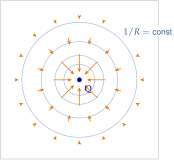
Section 2.3 · Topic 1 of 11
2.3.1 Position and displacement vectors
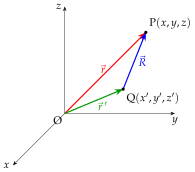
Field problems involve two kinds of points (Figure 2.3.1):
- the field point (observation point) , where we want to know the field, and
- the source point , where a source (a charge, a current element) is located.
Coordinates of source points are always written with a prime, while unprimed coordinates belong to the field point. This convention removes any doubt about which variables are held fixed when we integrate over a source distribution (the primed ones run) or differentiate a field (the unprimed ones vary).
Position vector
The position vector of is the vector from the origin to :
Its components are simply the coordinates of . Its magnitude is the distance of from the origin and is the unit vector pointing from the origin towards (it will become the radial unit vector of spherical coordinates in Section 2.3.6). Likewise the source point has
Displacement vector
The vector from the source point to the field point is the displacement vector. Since (head to tail, Figure 2.3.1),
is the distance between source and field point and is the direction “away from the source”. Coulomb's law (Section 3.1) and every field formula derived from it are written with these quantities. The order “field minus source” in is essential, because reversing it reverses the direction of the field.
is the arrow you would draw from the charge to the place where you measure: “where I am, minus where the source is”. Its length is the distance between them, and is the direction a positive charge pushes.
Writing (source minus field point). This vector points towards the source, and a field computed with it comes out with the wrong sign: a positive charge would seem to attract. Remember “field minus source”, and check that lands on .
A source sits at and we observe at the origin . Find and .
, , : at the origin “away from the source” means towards .