Section 2.3 · Topic 2 of 11
2.3.2 Coordinate systems
The symmetry of a problem often makes one coordinate system far more convenient than another: a line charge calls for cylindrical coordinates, a point charge for spherical ones. All the coordinate systems we use are orthogonal: at every point the three coordinate directions are mutually perpendicular. For a coordinate system with parameters we need to know three things for each coordinate (Table 2.3.1).
Table 2.3.1. What has to be known about an orthogonal coordinate system.
| Parameter definitions | Unit vectors | Scale factors (metric coefficients) |
|---|---|---|
- The parameter definitions express the Cartesian coordinates as functions of , so that the position vector becomes a function .
- The unit vector points in the direction in which moves when alone is increased. The three are mutually perpendicular and ordered so that (right-handed).
- The scale factor converts a change of the coordinate, , into a distance, . This is needed because a coordinate need not be a length: an angle is not (Figure 2.3.3).
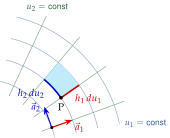
All three are contained in one relation. When only changes, by , the point moves by . The direction of this vector is and its length is . Therefore the first-order partial derivative of the position vector with respect to a parameter equals the scale factor times the unit vector:
A general small step changes all three coordinates. By the chain rule , which gives the differential length (differential displacement) vector
Increasing each coordinate by sweeps out a small box with perpendicular edges , , . Its faces are the differential areas, and as oriented areas (normal vector times area) they are
where is the face on which is constant. Its volume is the differential volume
Equations (2.3.6) to (2.3.8) are what we need to write line, surface and volume integrals in any orthogonal coordinate system. In Section 2.3.10 the same three scale factors will also give the gradient, divergence, curl and Laplacian in curvilinear coordinates.
A scale factor answers: “if I change this coordinate by a tiny amount, how many metres do I move?” For a coordinate that is already a length the answer is . For an angle the answer depends on how far from the centre we are. Once the three are known, every length, area and volume element is a product of edges .