Section 2.3 · Topic 7 of 11
2.3.7 The three coordinate systems at a glance
Everything in this course will be written in one of three coordinate systems. As we have seen, each is completely characterised by its coordinates, its unit vectors and its three scale factors. The differential elements, and (as we shall see in Section 2.3.10) every differential operator, follow from the scale factors alone. Figure 2.3.25 shows one and the same point described in the three systems, and Table 2.3.4 collects the data.
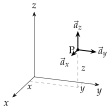
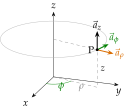
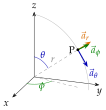
Table 2.3.4. The three orthogonal coordinate systems of the course side by side. The coordinates are listed in their right-handed order , and is the area element on the coordinate surface (its direction is ).
| Cartesian | cylindrical | spherical | |
|---|---|---|---|
| coordinates | |||
| ranges | all real | , | , , |
| coordinate surfaces | three planes | cylinder, half-plane, plane | sphere, cone, half-plane |
| unit vectors | |||
| do they vary? | no | vary with | all three vary with and |
| position vector | |||
| scale factors |
| Cartesian | cylindrical | spherical | |
|---|---|---|---|
| , , | , , | , , | |
The scale factor is what turns a change in the parameter into a change in length. A coordinate that is itself a length (, , , , ) has , whereas an angle has a scale factor equal to the radius of the circle along which that angle moves the point ( for the cylindrical , for , for the spherical ). The surface element on a coordinate surface is the product of the other two edges, , , .
Learn the three rows "scale factors" of Table 2.3.4 by heart and understand where they come from (lengths have , angles have radius of their circle). Everything else in the table can be reconstructed from them, and so can all four differential operators of Section 2.3.10.