Section 2.3 · Topic 4 of 11
2.3.4 Cylindrical coordinates
Many sources of practical interest (wires, coaxial cables, line charges, cylindrical capacitors) have an axis of symmetry. Describing them with and is clumsy, and it is much more natural to use the distance from the axis and the angle around it. Think of finding a seat in a round theatre: “row (how far from the stage centre), seat angle , balcony level ” is far more convenient than two perpendicular distances.
Coordinates and coordinate surfaces
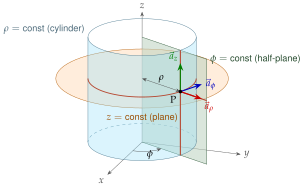
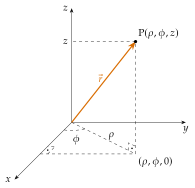
In circular cylindrical coordinates a point is described by (Figures 2.3.8 and 2.3.9):
- , the perpendicular distance from the -axis, ,
- , the angle measured from the -half-plane () to the half-plane containing , counter-clockwise when seen from , , and
- , the same as in Cartesian coordinates, .
The coordinate surfaces are a circular cylinder of radius around the -axis (), a half-plane hinged on the -axis (), and a plane perpendicular to the -axis (). The point is the single point that lies on all three (Figure 2.3.8).
Projecting onto the -plane we see from the right triangle in that plane (Figure 2.3.9) that
and conversely
The angle is fixed by the pair of relations for and . Neither alone suffices on the whole range : returns angles only in and only in , so holds only in the first quadrant. In general
which is what the two-argument function of programming languages computes (up to adding to its negative values). For example the point has and , not as alone would suggest. On the -axis () the angle is undefined.
Computing with a calculator. The ratio is the same for and , and returns angles between and only, so points in the second and third quadrants come out wrong by . Always look at the signs of and (or use Eq. (2.3.17), or ) to place the point in the correct quadrant.
Give the cylindrical coordinates of the Cartesian point .
. From and we get (by Eq. (2.3.17): ), and . Hence .
Position vector, unit vectors and scale factors
Inserting Eq. (2.3.15) into the Cartesian position vector,
Now we apply Eq. (2.3.5) to each coordinate in turn: differentiate , take the length of the result (the scale factor), and divide by it (the unit vector).
The coordinate ρ
Its length is , hence
points horizontally away from the -axis, along the projection of on the -plane. Since is itself a length, no scale factor is needed.
The coordinate φ
The bracket has unit length, so
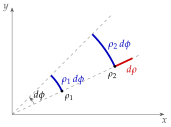
is horizontal, tangent to the circle of radius around the -axis, in the direction of increasing . The scale factor expresses the fact that an increase of the angle moves the point along an arc of length : the farther from the axis, the longer the arc (Figure 2.3.10).
The coordinate z
One checks directly from Eqs. (2.3.19) and (2.3.20) that , and that both are perpendicular to : the system is orthogonal. It is also right-handed, the cyclic order being :
Finally, since , the position vector (2.3.18) takes the compact form
There is no term: the angle of is hidden inside , which is different for different .
The unit vectors depend on position
Equations (2.3.19) and (2.3.20) contain : the directions of and change from point to point (Figure 2.3.11), while is constant. Differentiating,
(For example .) This has two practical consequences that we shall meet again and again.
- Components of vectors at different points cannot simply be added. For example the unit vector at is , and at it is , so their sum is , not “”. When the contributions of a source distribution are summed by an integral, and must be expressed through the constant Cartesian unit vectors before they are taken out of the integral.
- Derivatives of a vector field act on the unit vectors too. This is why the divergence and curl in cylindrical coordinates are not obtained by merely replacing by in Eqs. (2.2.6) and (2.2.8). The correct forms are derived in Section 2.3.10.
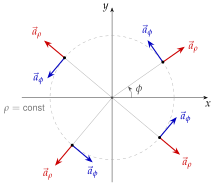
Change in the explorer below and watch and rotate with the point while stays fixed. The three coordinate surfaces through the point are a cylinder, a half-plane and a plane.
Adding unit vectors that belong to different points. For a ring of charge around the -axis, each small piece at angle produces at a point on the axis a field whose horizontal part points along evaluated at (from the piece towards the axis). These are different vectors for different pieces (for two opposite pieces, at and , they are and ), so the horizontal parts cancel instead of adding up to a large multiple of “”. Before adding or integrating, write and with Eqs. (2.3.19) and (2.3.20) in terms of and .
What are and at a point with (on the positive -axis)?
From Eqs. (2.3.19) and (2.3.20) with , : (away from the axis, along ) and (counter-clockwise seen from above). Check: .
Differential elements
With , , , the general results (2.3.6) to (2.3.8) give
Figure 2.3.12 shows the volume element. It is bounded by the cylinders and , the half-planes and , and the planes and . Its edges have lengths (radial), (an arc of radius ) and (vertical). To first order it is a rectangular box, and its volume is the product of the three edges. Each face is the product of two edges: the curved face on the cylinder has area , the flat face on a half-plane has area , and the top and bottom faces have area . A useful check of any cylindrical expression is dimensional: is dimensionless, so it must always be accompanied by a length to form an arc, an area or a volume with the right units.
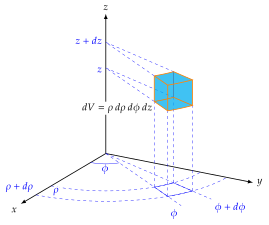
In cylindrical coordinates every step in must be multiplied by to become a length: . That single factor is the origin of the in , in and in . Patches with the same and are bigger far from the axis than near it.
Forgetting the Jacobian : writing or . The result then has the wrong units (one power of length is missing) and the wrong value: for a disc of radius one would get instead of (Example 2.3.12).
What is the length of a quarter of the circle (in the plane ), and what is the area of the quarter disc , ?
Length: . Area: . (The two numbers are equal only because , and their units are different: and .)