Section 2.3 · Topic 9 of 11
2.3.9 Integration in spherical coordinates
The surface and volume elements, Eqs. (2.3.40) and (2.3.41), turn integrals over spheres, which would be awkward in Cartesian coordinates, into products of simple one-dimensional integrals. The procedure is always the same.
Recipe · Evaluating line, surface and volume integrals
- Choose the coordinate system in which the boundary of the region is a coordinate surface (a sphere centred at the origin is , a cylinder around the axis is ).
- Take the corresponding element , or from Eqs. (2.3.39) to (2.3.41) (or Table 2.3.4), scale factors included, and fix the sign of by the required orientation.
- Choose the limits so that every point of the region is covered exactly once (, for a full sphere).
- If the integrand is a vector dotted with or , evaluate the dot product before integrating. If the integrand is a vector, convert its unit vectors to Cartesian ones.
- If the limits are constants and the integrand is a product of functions of one variable each, split the multiple integral into a product of single integrals.
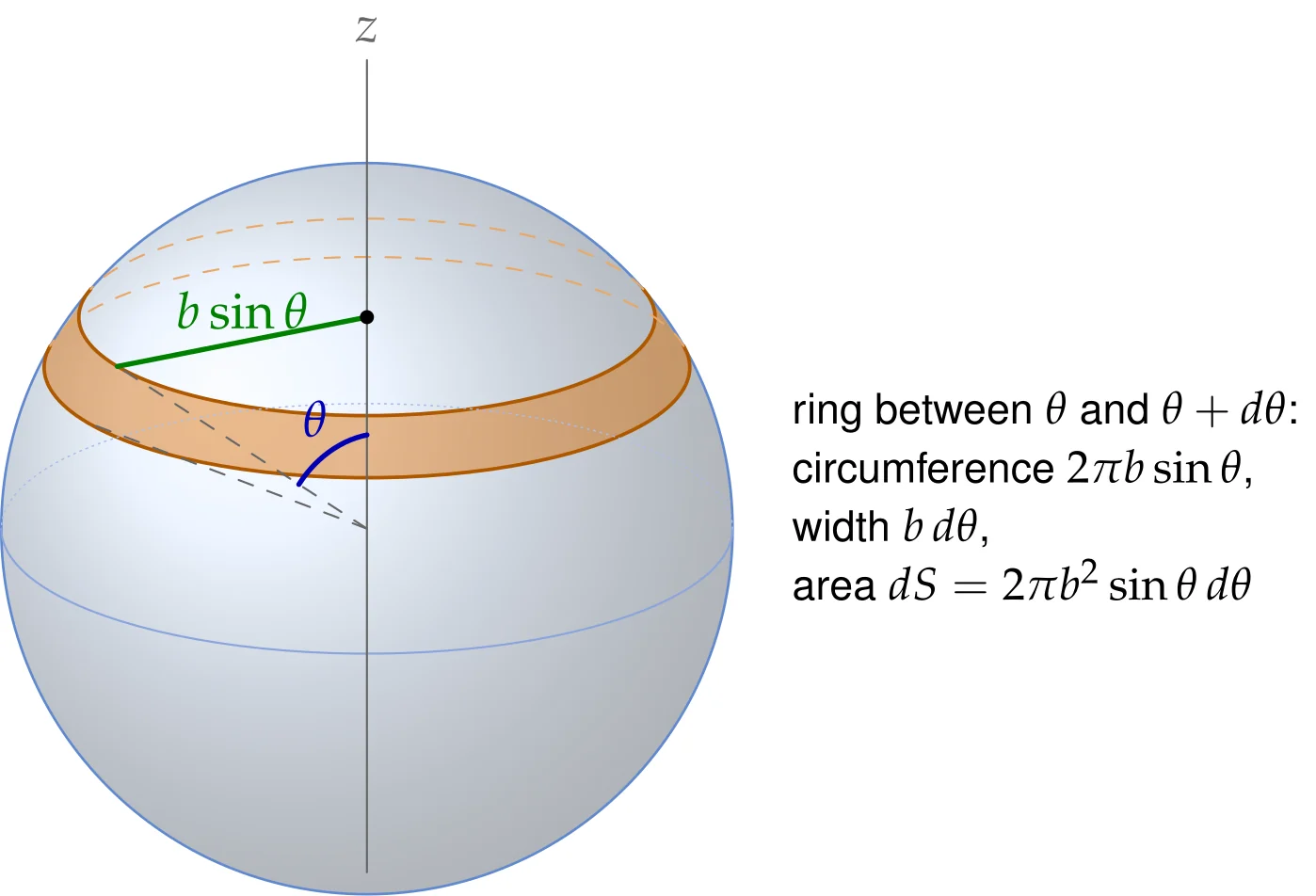
The three examples of this subsection show how this works. Figure 2.3.27 gives a useful picture for the first one.
Quick check
Without a new calculation: what is the area of the northern hemisphere () of a sphere of radius , and what is the area of the polar cap ?
. For this is (half the sphere), and for it is , a quarter of the sphere, although the cap reaches one third of the way from pole to pole.