Section 3.3 · Topic 2 of 8
3.3.2 Work, potential difference and the reference point
Work done in moving a charge
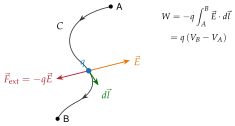
Let us compute the work needed to move a point charge against a given electrostatic field along a curve from a point A to a point B (Figure 3.3.4). The field exerts the force on the charge. To carry the charge slowly, so that it gains no kinetic energy, an external agent (our hand) must apply the opposite force . On a small displacement it does the work . Adding up along and using Eq. (3.3.5),
The last step uses the defining property of the gradient (Section 2.2): along a small displacement the change of is
so the line integral of is just the sum of the small changes of along the path, , exactly as the total climb of a walk is the final height minus the starting height, however many ups and downs there were in between.
Equation (3.3.11) has several important consequences.
-
The work does not depend on the path between A and B. Only the values of the potential at the two end points enter. Any curve from A to B (straight, wiggly, or one that wanders far away and comes back) requires the same work (Figure 3.3.5). Home exercise 3.3.6 verifies this for two different paths.
-
Only potential differences are physically meaningful. The work, the field and the force are all determined by differences or derivatives of , and the arbitrary constant in Eq. (3.3.4) cancels from all of them. The potential difference or voltage between B and A,
is the work per unit charge needed to carry a charge from A to B. This is also what a voltmeter measures. From Eq. (3.3.12), .
-
We may choose as we wish. The constant has no effect on measurable quantities such as the field and the force, because these require a differentiation. Choosing amounts to choosing the point at which the potential is zero, the reference point.
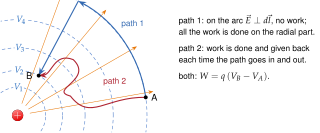
A voltage is a "height difference" for charges: volts means that every coulomb carried from A to B needs joules. How you carry it does not matter.
The rule is : the lower limit is the starting point A, the upper limit the end point B, and there is a minus sign. Equivalently . Swapping the limits and dropping the minus sign gives an equivalent, correct form, , whereas changing only one of them gives the wrong sign. A quick test: moving along the potential must decrease.
A charge is carried from a point at to a point at . How much work does the external agent do? And the field?
. The agent does negative work (it holds the charge back), and the field does . A positive charge "rolls downhill" to lower potential by itself.
The reference at infinity
Unless explicitly stated otherwise, we shall fix such that at infinity, . With the integral formulas (3.3.4)–(3.3.6) do exactly this for any charge distribution of finite extent, since every term vanishes as . Taking A at infinity and B at the point in Eq. (3.3.12),
can be interpreted as the work that must be done to bring a unit positive point charge from infinity to the point P (slowly, and without disturbing the charges that produce the field). A positive potential means that work must be done against a repelling field, whereas a negative potential means that the field itself pulls the charge in.
Check: the point charge
For a point charge at the origin, Coulomb's law gives . Integrating along a radial line from to infinity, where ,
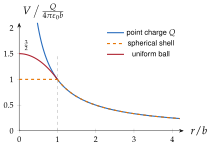
which agrees with Eq. (3.3.6) for : the two definitions of the potential (as an integral over the charges and as a line integral of the field) give the same function when . Figure 3.3.6a compares this curve with the potentials of a charged spherical shell and of a uniformly charged ball, obtained in Exercise 3.3.3 (by integrating over the charge) and in Exercise 3.3.7 (by integrating the field in exactly this way).
- Find everywhere along a convenient path (Coulomb's or Gauss's law, Sections 3.1 and 3.2).
- Choose the reference point where : infinity for a charge distribution of finite size, a finite point (an earthed conductor, a chosen radius ) otherwise.
- Write , integrating from P to the reference along the simplest path (usually radial, since the result does not depend on the path).
- If has different formulas in different regions, split the integral at the boundaries (e.g. ). is continuous across the boundaries.
- Check: decreases along , and far from a finite source .
When infinity cannot be the reference
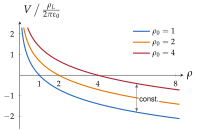
For charge distributions that extend to infinity, such as an infinitely long line charge or an infinite charged plane, the integral (3.3.13) diverges and cannot be imposed. For the infinite line, gives
whose magnitude grows without bound as (Figure 3.3.6b). One then chooses a finite reference point , where , for instance the earthed screen of a coaxial cable (Problem 3.3.2) or the mid-plane of a two-wire line (Exercise 3.3.4). In circuits the reference is the "ground" node. Home exercise 3.3.1 shows how the potential of a finite line becomes unbounded as its length grows. The trouble is not physical: real lines are finite. It only says that an idealised infinite source contains infinite charge, which makes "the work to come in from infinity" infinite.
Writing gives , not a potential. For sources that extend to infinity always choose a finite reference, .
A statement such as "this wire is at 5 V" has a meaning only together with a reference ("with respect to the chassis"). Adding the same constant to everywhere changes no field, no force and no work. Two solutions that differ by a constant describe the same physics, so do not treat them as a contradiction.
Somebody adds to the potential at every point of space. What happens to , and to the work needed to move a charge from A to B?
Nothing: and involve only derivatives and differences, from which the constant drops out. Only the reference point has moved.