Section 3.3 · Problems · 2 of 3
Problem 3.3.2: Laplace's equation in \rho only
Laplace's equation in only
#Suppose that there is no source between two infinitely long coaxial circular cylinders of radii and . Find the explicit expression of the potential function by assuming that it has known constant values and on the cylinders as shown in the figure. Determine the electric field between these cylinders. Find the total charge on the outer surface if the length of the cylinders is .
Adapted from: D. K. Cheng, Field and Wave Electromagnetics, 2nd ed., Example 4-8.
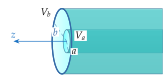
The same plan in cylindrical coordinates: no charge between the cylinders (Laplace), infinitely long cylinders and -independent boundary values (so ), the radial part of the cylindrical Laplacian (3.3.16), two boundary conditions, then and .
Laplace's equation in cylindrical coordinates (3.3.16) reads
The cylinders are infinitely long and the boundary values do not depend on : sliding along or rotating about the axis changes nothing. Hence , and
and give
Subtracting, , and then :
Hence
(The second form makes the boundary values evident: is at and at .)
Only the -component of the gradient survives:
The charge of the outer conductor sits on its inner face, , whose normal pointing out of the conductor into the gap is :
It is uniform over the area of a length , so
At the outward normal is and , so the inner cylinder carries .
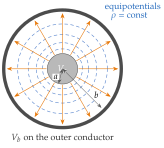
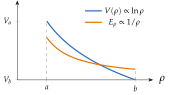
The second form of gives at and at . For the field points outwards, from high to low potential. The charges on the two cylinders are equal and opposite, and has the unit .
and : between the cylinders the field is that of a line charge on the axis (Problems 3.1.1 and 3.2.1), but now with the voltage as the given quantity. Equal steps of give equipotential cylinders whose radii form a geometric progression (Figure 3.3.23), and the field is largest at the inner conductor, the place where breakdown would start (Exercise 3.3.10). The ratio is the capacitance of a coaxial line of length (Section 3.4).
The solver below finds the same logarithmic potential numerically: compare the spacing of its equipotentials with the analytic law, then shrink the inner conductor and watch the field crowd against it.