Section 3.3 · Further exercises · 9 of 10
Exercise 3.3.9: Laplace's equation in \phi only: a wedge
About the further exercises of Section 3.3
The following exercises use only the relations collected at the beginning of this subsection. Exercises 3.3.1–3.3.4 compute potentials from the charge distribution, Exercises 3.3.5–3.3.7 work from the field or the potential, and Exercises 3.3.8–3.3.10 solve Laplace's and Poisson's equations.
Laplace's equation in only: a wedge
#cf. Problem 3.3.2
Two semi-infinite conducting planes and meet along the -axis, where they are insulated from each other. The plane is grounded and the plane is at . Find and in the region , and the surface charge density on the plane .
Adapted from: D. K. Cheng, Field and Wave Electromagnetics, 2nd ed., Problem P.4-23.
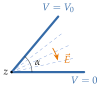
The boundary values depend only on , so and only the -term of the cylindrical Laplacian (3.3.16) survives. Remember the factor in the -component of the gradient.
Laplace's equation in cylindrical coordinates (3.3.16). The boundary values depend only on , and nothing changes along or with on either plane, so and
The boundary conditions and give , :
The gradient in cylindrical coordinates has the -component :
On the plane the normal pointing out of the conductor into the gap is :
and are reproduced. For the field points along , from the plane at to the earthed plane, and has the unit V/m.
The equipotentials are the half-planes and the field lines are circular arcs centred on the edge. The field and the surface charge grow as towards the edge, where the two plates come closest, and in practice the gap at the edge is where breakdown would start.