Section 3.3 · Home exercises · 2 of 9
Home exercise 3.3.2: Circular disk source
Circular disk source
#A circular disk of radius in the -plane, centred at the origin, carries a uniform surface charge density . Find the electrostatic potential at a point on its axis (), and from it the electric field. Evaluate both at and compare with Problem 3.1.3.
Source: D. K. Cheng, Field and Wave Electromagnetics, 2nd ed., Example 3-9.
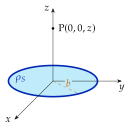
Superposition over the disk, cut into rings (cylindrical coordinates, ). Every point of a ring of radius is at the same distance from P, so the integral is elementary. On the axis the field is along by symmetry: .
A source point of the disk is with , , so
With the electrostatic potential is
the -integration simply giving because the integrand does not depend on . With the change of variables , , the integrand becomes , whose integral is :
On the axis the field is along by symmetry, and
At :
Just above the disk () the field tends to , the field of a charged sheet, as it must very close to the surface, and far away it becomes the point-charge field (remark below). has the unit .
The field agrees with Problem 3.1.3, where it was obtained by integrating . At the centre of the disk . Far away (), and , the potential of a point charge . For the field tends to , that of an infinite sheet, while the potential again diverges.
Move the field point from the disk surface to far away: near the disk approaches the sheet value , far away both and follow the point-charge curves.