Section 3.3 · Further exercises · 4 of 10
Exercise 3.3.4: Voltage of a two-wire line
About the further exercises of Section 3.3
The following exercises use only the relations collected at the beginning of this subsection. Exercises 3.3.1–3.3.4 compute potentials from the charge distribution, Exercises 3.3.5–3.3.7 work from the field or the potential, and Exercises 3.3.8–3.3.10 solve Laplace's and Poisson's equations.
Voltage of a two-wire line
#cf. Home exercise 3.3.1
Two long parallel wires of radius are a distance apart and carry and per unit length. Treating each wire as a line charge on its axis,
(a) find the potential at a point at distances and from the two wires, taking on the mid-plane,
(b) find the voltage between the wires, and
(c) evaluate it for , , .
Adapted from: B. M. Notaroš, Electromagnetics, Example 2.15.
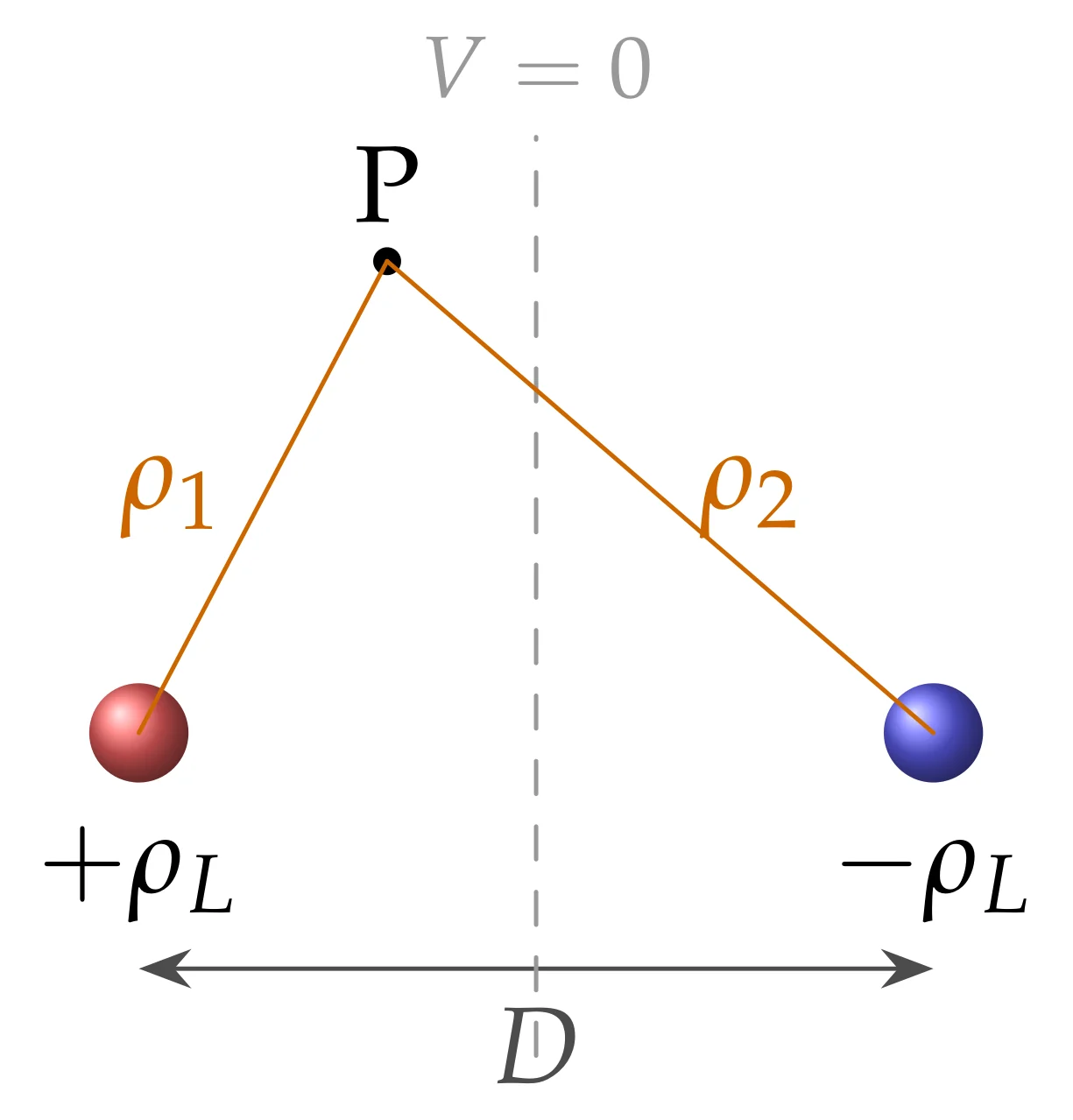
For infinite lines infinity cannot be the reference. Write the potential of one line with an arbitrary constant, superpose the two lines, and fix the constant by on the mid-plane.
For one infinite line charge (Problem 3.2.1), so between two radii
(The reference cannot be at infinity: for an infinite line the potential grows without bound there.) Superposing the potentials of and ,
and on the mid-plane, where , gives :
On the surface of the positive wire and, since , . By symmetry the negative wire is at the opposite potential:
With and ,
On the mid-plane and , near the positive wire () is positive and large, and the unit of is V. Numerically , times , gives .
The equipotentials are circles (circles of Apollonius) around each wire. Treating the wires as line charges on their axes is accurate for . For closer wires the charge on each wire is pulled towards the other. The ratio is the capacitance per metre of the two-wire line (Section 3.4).