Section 3.3 · Topic 3 of 8
3.3.3 The first fundamental equation of electrostatics
No whirlpools
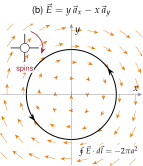
Imagine that the electrostatic field had a "whirlpool" somewhere: a region where the field lines circulate, like water swirling around a drain (Figure 3.3.7b). A charge carried once around the whirlpool, always moving with the field, would gain energy on every lap, and we could drive a generator with it forever, from a fixed arrangement of charges. The landscape picture shows why this cannot happen: a walk that returns to its starting point has a total climb of zero. Since , the same must be true for the work done by the electrostatic field around any closed path. Let us turn this into an equation.
The electrostatic field is the gradient of a scalar function, and gradients have a special property: their curl is identically zero. To see this, take the -component of (Section 2.2):
because the order of the mixed second derivatives of a smooth function does not matter. The - and -components vanish in the same way. Applying this to gives the differential form. The integral form follows from Stokes's theorem (Section 2.4): for any closed curve bounding a surface ,
It can also be read off directly from Eq. (3.3.11): a closed path starts and ends at the same point, so .
Around any closed loop, the electrostatic field does zero net work: what it gives on one part of the loop it takes back on another. A small paddle wheel placed in an electrostatic field never starts to spin.
Meaning
The integral form states that no net work is done on a charge carried around any closed path in an electrostatic field. A field with this property is called conservative (the energy put in on one part of the path is recovered on the rest) or irrotational (it has no curl). Two immediate consequences:
- Electrostatic field lines never close on themselves. Along a closed field line would be positive everywhere and the circulation could not vanish. Electrostatic field lines therefore begin on positive charges and end on negative charges (or at infinity).
- Applied to a closed loop in a circuit, says that the voltages around the loop add up to zero: Kirchhoff's voltage law is the first fundamental equation of electrostatics in circuit language.
A test for electrostatic fields
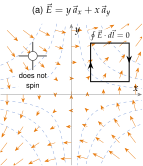
The argument can be reversed: if everywhere in a region (without holes), the line integral of between two points is independent of the path, and a potential with can be constructed from Eq. (3.3.12). A given vector field can therefore be an electrostatic field only if its curl vanishes. For example, (Figure 3.3.7b) has
Around a circle of radius about the origin, traversed counter-clockwise, and , in agreement with Stokes's theorem ( times the area ). This field cannot be produced by static charges. In contrast, (Figure 3.3.7a) is curl-free, and it is the negative gradient of . Home exercise 3.3.6 does the same for and . Home exercise 3.3.5 and Exercise 3.3.6 use the test to decide whether given fields are electrostatic.
- Compute (with the curl formula of the coordinate system in which is given). If it is not zero everywhere, stop: the field is not electrostatic.
- Otherwise integrate one component of , e.g. , keeping an unknown "constant" .
- Differentiate the result with respect to the next variable, compare with , and fix up to a function of the remaining variable. Repeat with .
- Fix the last constant with the reference condition and check that gives back .
Let and be two paths from A to B. Going out along and back along is a closed curve. If this closed curve bounds a surface lying entirely in the region where , Stokes's theorem gives : the two line integrals are equal, and defines a potential. If the region has a hole that the closed curve goes around, no such surface may exist. A classical example is : its curl is zero for , but on the -axis it is not defined, and around any circle about the axis . Such a field is not the gradient of a single-valued potential. Fields produced by static charges never behave like this.
Equation (3.3.14) and Gauss's law (Section 3.2) specify the curl and the divergence of the electrostatic field. Together they are the two fundamental equations of electrostatics in free space. The first one holds for static fields: when magnetic fields vary in time, Faraday's law of induction (studied later in the course) gives , and the electric field is then no longer the gradient of a potential alone.
Is a possible electrostatic field? If so, give a potential.
Yes: , and the other components vanish too. , and indeed .