Section 3.3 · Further exercises · 8 of 10
Exercise 3.3.8: Poisson's equation for a charged slab
About the further exercises of Section 3.3
The following exercises use only the relations collected at the beginning of this subsection. Exercises 3.3.1–3.3.4 compute potentials from the charge distribution, Exercises 3.3.5–3.3.7 work from the field or the potential, and Exercises 3.3.8–3.3.10 solve Laplace's and Poisson's equations.
Poisson's equation for a charged slab
#An infinite slab carries a uniform volume charge density , and outside it there is no charge. Taking , solve Poisson's and Laplace's equations to find and everywhere.
Adapted from: B. M. Notaroš, Electromagnetics, Problem 1.61.
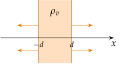
Solve Poisson's equation inside and Laplace's equation outside, in one variable. Symmetry fixes one constant, the reference another, and continuity of and at (no surface charge) the rest.
The slab is infinite in and , so depends on only, and since the slab is symmetric about , .
Poisson's equation:
Symmetry gives and gives :
Laplace's equation gives . With no surface charge both and (i.e. ) are continuous at :
The region follows by symmetry. Altogether
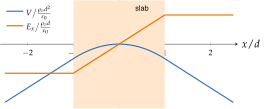
At the inner formula gives and the outer one
is continuous, and so is (Figure 3.3.27).
Outside, the slab acts like a sheet of charge per unit area: , the limit of the disk of Problem 3.1.3. Inside, grows linearly and is a parabola.
The same chain, charge to field to potential, governs the depletion layer of a pn junction, which consists of two oppositely charged layers of this kind. Change the doping on the two sides and the applied voltage, and watch the charge, the field and the potential change together.