Section 3.3 · Home exercises · 1 of 9
Home exercise 3.3.1: Finite line source
Finite line source
#A line charge of uniform density lies on the -axis from to . Find the electrostatic potential at the point , and from it the electric field at .
Source: D. K. Cheng, Field and Wave Electromagnetics, 2nd ed., Problem P.3-16.
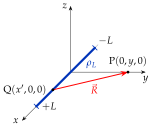
Superposition of charges: one scalar integral of along the line, then . Symmetry tells us that on the -axis only survives, so the derivative along the axis is enough (see the mistake box on differentiating a potential known only on a line, Section 3.3.1).
A source point on the line is , so the displacement vector is
With the potential integral is
using the standard integral . This gives
On the -axis the field has only a -component: the contributions of the elements at and cancel along , and all charges lie in the plane . The -derivative can therefore be taken along the -axis itself. Writing , so that ,
The bracket equals , so
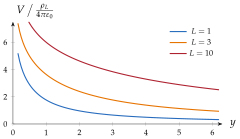
Far away (), and , so
a point charge , as expected. The unit of is .
This is the result of Home exercise 3.1.1, obtained there by integrating directly. With the potential only one scalar integral is needed. For the field tends to , the infinite line charge of Problem 3.1.1. The potential, however, grows without bound (Figure 3.3.25): since , . For an infinitely long line the reference cannot be used.