Section 3.3 · Problems · 1 of 3
Problem 3.3.1: Laplace's equation in one variable
Laplace's equation in one variable
#Consider a parallel-plate capacitor with the plates located at and with constant potentials volts and volts, respectively. Assuming no charge between the plates, determine the electrostatic potential and the electric field inside the capacitor. Find the total charge on the plate above if the surface area of the plates is each.
Adapted from: D. K. Cheng, Field and Wave Electromagnetics, 2nd ed., Example 4-1.
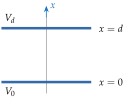
There is no charge between the plates, so obeys Laplace's equation. Plates much larger than their spacing make depend on only, which turns Laplace's equation into an ordinary differential equation, and the two plate voltages fix its two constants. The charge then follows from (recipe of Section 3.3.5).
There is no charge between the plates, so the potential satisfies Laplace's equation,
The plates are taken to be infinite in the - and -directions (their size is much larger than their spacing , and we ignore the fringing at the edges, Figure 3.3.13a). Shifting the observation point parallel to the plates then changes nothing, so depends on only, and Laplace's equation reduces to an ordinary differential equation:
The two plates are conductors at given potentials:
The first gives , the second , i.e. . Hence
The gradient has only an -component:
The field is uniform. For it points in the direction, from the plate at the higher potential to the plate at the lower one, as it must.
The charge resides on the lower surface of the upper plate, facing the gap. There the normal pointing out of the conductor into the gap is , so
Since is uniform over the area ,
On the upper surface of the lower plate the outward normal is and : the lower plate carries .
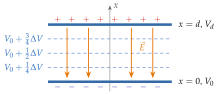
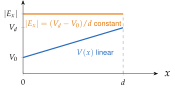
and are reproduced, has the unit V/m and points from the plate at the higher potential to the other, the two plates carry , and the unit of is .
is linear and uniform: the equipotentials are equally spaced planes parallel to the plates (Figure 3.3.22). The magnitude of the field is simply "voltage divided by spacing", the familiar rule for parallel plates. The charge is proportional to the voltage, and the ratio is the capacitance of the parallel-plate capacitor (Section 3.4). The same uniform field accelerates the electrons of the gun in Application 3.3.1.