Section 3.3 · Home exercises · 3 of 9
Home exercise 3.3.3: Annular disk source
Annular disk source
#An annular disk , , carries a uniform surface charge density . Find the electrostatic potential at a point on its axis (), and from it the electric field. Evaluate both at and check the limit .
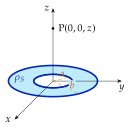
Exactly as in Home exercise 3.3.2, except that the lower limit of the -integration changes from to .
The displacement vector is the same as in Home exercise 3.3.2,
and only the limits of change:
At :
Then and : both results reduce to those of Home exercise 3.3.2, as they must.
Far away (),
the point-charge potential of the total charge of the annulus. The limit was checked above.
The field vanishes at the centre of the hole (), although the potential there, , is not zero: a zero field means a stationary potential, not a zero potential. For , since for and, by symmetry, for , the potential on the axis has its maximum at the centre of the hole, but only along the axis. In the plane of the ring the potential increases towards the charged ring, so the centre is a saddle point, consistent with the absence of extrema in a charge-free region.
Shrink the inner radius to zero and the curves turn into those of the full disk. With a large hole, notice that starts from zero at the centre, rises to a maximum and only then decays.