Section 3.3 · Further exercises · 3 of 10
Exercise 3.3.3: Charged spherical shell by direct integration
About the further exercises of Section 3.3
The following exercises use only the relations collected at the beginning of this subsection. Exercises 3.3.1–3.3.4 compute potentials from the charge distribution, Exercises 3.3.5–3.3.7 work from the field or the potential, and Exercises 3.3.8–3.3.10 solve Laplace's and Poisson's equations.
Charged spherical shell by direct integration
#cf. Home exercise 3.3.2
A spherical surface of radius carries a uniform surface charge density . Find the electrostatic potential at every point by integrating over the charge, and from it the electric field.
Adapted from: D. K. Cheng, Field and Wave Electromagnetics, 2nd ed., Example 3-2.
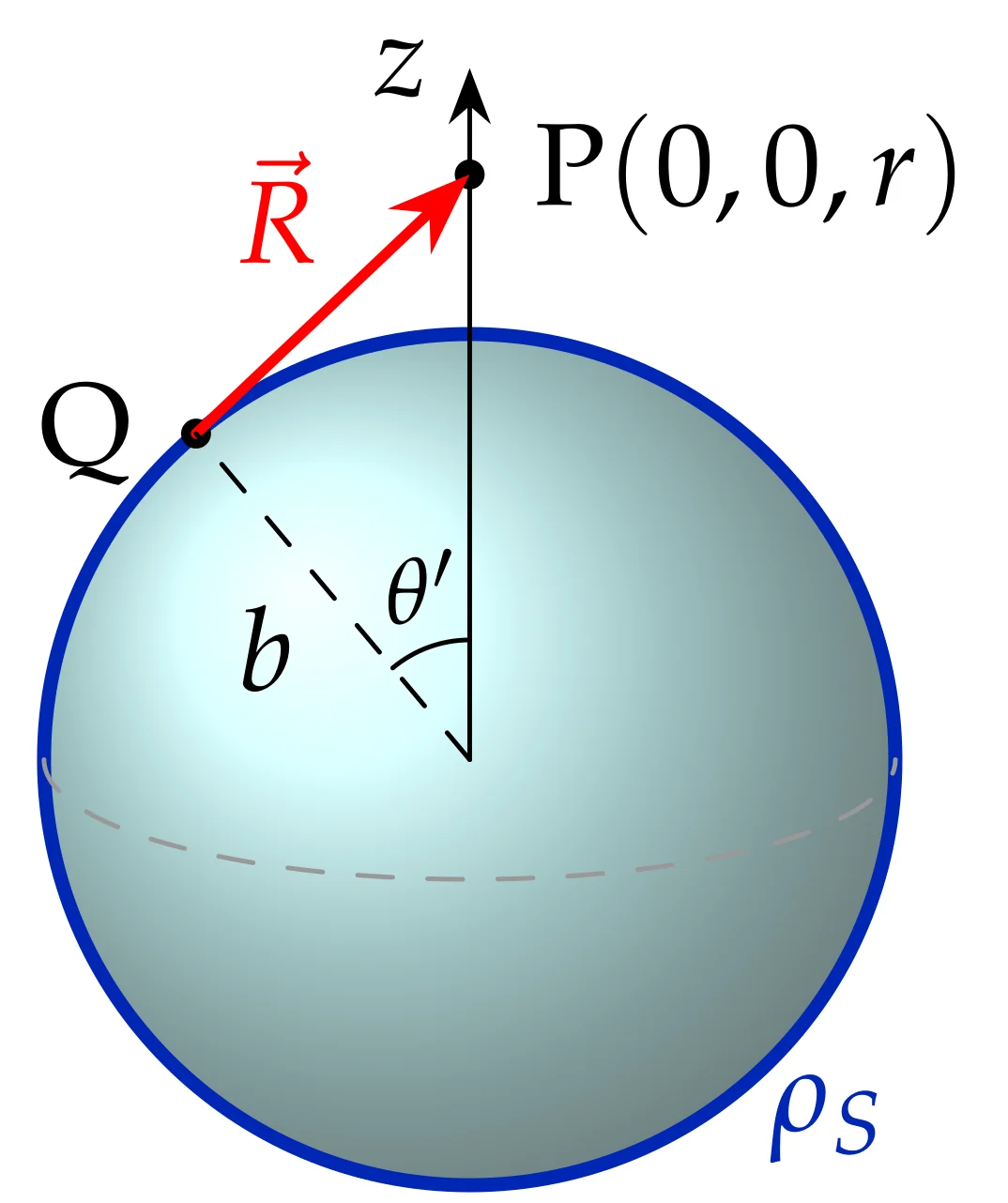
Superposition over the sphere. By symmetry we may put P on the -axis. The distance follows from the law of cosines and the substitution makes the integral elementary.
By symmetry depends only on the distance from the centre, so we may place P on the -axis, . For a source point on the sphere at polar angle the law of cosines gives
Then
where the -integration gave and we substituted , . The integral is elementary:
since . This equals for and for . Hence
and :
is continuous at (both formulas give ), and for the shell acts like a point charge .
Inside the shell the potential is constant, so the field is zero. Outside, the shell acts like a point charge at its centre. The potential is continuous at , while the field jumps by . Gauss's law gives the same field in two lines (Exercise 3.2.5 with a single charged shell). When the symmetry is high, Gauss's law is the faster route.