Section 3.3 · Further exercises · 10 of 10
Exercise 3.3.10: Coaxial line for the highest voltage
About the further exercises of Section 3.3
The following exercises use only the relations collected at the beginning of this subsection. Exercises 3.3.1–3.3.4 compute potentials from the charge distribution, Exercises 3.3.5–3.3.7 work from the field or the potential, and Exercises 3.3.8–3.3.10 solve Laplace's and Poisson's equations.
Coaxial line for the highest voltage
#cf. Problem 3.3.2, Home exercise 3.3.8
An air-filled coaxial line has a fixed outer conductor radius . Air breaks down at .
(a) Using Problem 3.3.2, express the largest voltage the line can hold as a function of the inner radius .
(b) Find the value of that maximises it, and the maximum voltage.
Adapted from: B. M. Notaroš, Electromagnetics, Example 2.29.
Take the coaxial field from Problem 3.3.2. Breakdown starts at the inner conductor, where the field is largest. This gives the largest voltage as a function of , which we then maximise.
From Problem 3.3.2, with . The field is largest at , so breakdown is avoided as long as
Setting the derivative to zero,
(The second derivative, , confirms a maximum.)
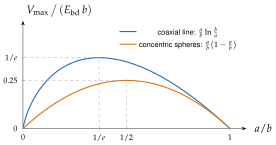
At the optimum , so , exactly the breakdown field (Figure 3.3.28).
A thin inner conductor concentrates the field (), while a thick one leaves too small a gap. The optimum is the classical result for high-voltage coaxial design, analogous to for concentric spheres (Home exercise 3.3.8).