Section 3.3 · Further exercises · 5 of 10
Exercise 3.3.5: An electrostatic quadrupole lens
About the further exercises of Section 3.3
The following exercises use only the relations collected at the beginning of this subsection. Exercises 3.3.1–3.3.4 compute potentials from the charge distribution, Exercises 3.3.5–3.3.7 work from the field or the potential, and Exercises 3.3.8–3.3.10 solve Laplace's and Poisson's equations.
An electrostatic quadrupole lens
#cf. Home exercise 3.3.5
In the region between four hyperbolic electrodes the potential is , where and are constants.
(a) Show that the region is free of charge.
(b) Find .
(c) Find the force on a positive charge near the axis and describe its effect on a beam travelling along .
Read Poisson's equation backwards for the charge, take the gradient for the field, and use .
Poisson's equation gives the charge density:
The potential satisfies Laplace's equation: there is no charge between the electrodes.
The force is :
In the -direction the force is a restoring force proportional to the displacement: the beam is focused. In the -direction it pushes the charge further out: the beam is defocused.
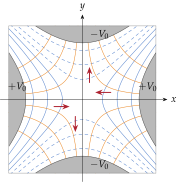
The field must be perpendicular to the equipotentials , whose tangent direction is : indeed .
The equipotentials and the field lines are two families of hyperbolas crossing at right angles (Figure 3.3.26). The field grows linearly from zero on the axis. Because a quadrupole focuses in one plane and defocuses in the other, accelerators and beam lines use pairs of quadrupoles rotated by , which focus in both planes overall (a quadrupole mass filter instead alternates its electrode voltages at radio frequency). A field that does not change along the beam cannot focus in both transverse directions at once: Laplace's equation forces the two curvatures of to have opposite signs, which is a two-dimensional form of Earnshaw's theorem (Section 3.3.5).