Section 4.3 · Topic 3 of 10
4.3.3 The electric analogue
A winding of turns around a branch links the loop times, so the current on the right-hand side of the loop equation is , not (Figure 4.3.4a). This product is the quantity that drives the flux, and it gets a name of its own.
The magnetomotive force (mmf) of a winding of turns carrying the current is
usually quoted in ampere-turns (At) to recall where it comes from. It is the circulation of around any closed path that threads the winding once.
With this, the single-loop core of Figure 4.3.4a obeys , which looks exactly like Ohm's law for the electric circuit of Figure 4.3.4b. The resemblance is not a coincidence: a resistor of length , cross-section and conductivity has because and the voltage drop is , while a branch of a core has because and the magnetic potential drop is . The current is the flux of , the magnetic flux is the flux of , and both are conserved at nodes. Table 4.3.1 lists the dictionary.
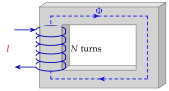
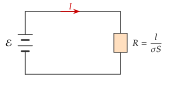
Table 4.3.1. The dictionary between a magnetic circuit and a resistive electric circuit.
| magnetic circuit | electric circuit |
|---|---|
| magnetomotive force (A, "At") | electromotive force (V) |
| flux (Wb) | current (A) |
| reluctance () | resistance () |
| permeability , | conductivity , |
| magnetic potential drop (A) | voltage drop (V) |
| around a loop | around a loop |
| at a node | at a node |
Ampere-turns push flux through reluctance, as volts push current through resistance. Every rule you know for resistor networks (series, parallel, mesh and node equations) can be used, with the dictionary of Table 4.3.1.
The analogy is formal, and it fails in two places. First, is a constant, whereas depends on (Section 4.3.6): a magnetic circuit with iron in it is nonlinear, and is only useful while the iron is far from saturation. Second, flux always leaks. The ratio is to , whereas is about : air is a nearly perfect insulator for current but a rather poor insulator for flux, so a few per cent of the flux take short cuts outside the core (Section 4.3.8). There is no magnetic "wire" as good as a copper wire.
A closed ring core of mean length , cross-section and carries turns with . What are , and ?
, and (Exercise 4.3.1 continues this calculation).