Section 4.3 · Further exercises · 3 of 10
Exercise 4.3.3: Two materials in series, from the curves
About the further exercises of Section 4.3
Ten further exercises in the spirit of Problems 4.3.1–4.3.3, the applications and the home exercises. They use only
Where a material is nonlinear the – curves of Figure 4.3.19 are used, with the readings given in the statement. Exercises 4.3.1–4.3.4 are about reluctance, flux and inductance, Exercises 4.3.5–4.3.6 about transformers and motors, and Exercises 4.3.7–4.3.10 about recording heads, electromagnets, fringing and leakage. Constant: .
Two materials in series, from the curves
#cf. Problem 4.3.1
A closed core of uniform cross-section is made of of sheet steel and of cast steel joined end to end (no gaps), with a coil of turns. From the lecture's curves, at the sheet steel needs and the cast steel . (a) Find the current that gives in the core. (b) If a gap is cut in the core, what current is needed for the same (neglect fringing)? (c) What fraction of the mmf is taken by the cast steel in (a), and by the gap in (b)?
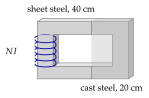
One flux tube of uniform area, so everywhere, and the nonlinear loop rule (4.3.21) with the two readings given.
Ampère's law round the mean path:
The gap adds (the iron lengths shrink by , negligible):
In (a) the cast steel, one third of the path, takes of the mmf. In (b) the gap, of the path, takes .
Two lessons of Problem 4.3.1 again: the poorer material dominates the iron share even when it is the shorter piece, and a sub-millimetre gap outweighs the whole iron path. If the core were all sheet steel the mmf of (a) would be , so the of cast steel cost extra.