Section 4.3 · Further exercises · 9 of 10
Exercise 4.3.9: Fringing correction
About the further exercises of Section 4.3
Ten further exercises in the spirit of Problems 4.3.1–4.3.3, the applications and the home exercises. They use only
Where a material is nonlinear the – curves of Figure 4.3.19 are used, with the readings given in the statement. Exercises 4.3.1–4.3.4 are about reluctance, flux and inductance, Exercises 4.3.5–4.3.6 about transformers and motors, and Exercises 4.3.7–4.3.10 about recording heads, electromagnets, fringing and leakage. Constant: .
Fringing correction
#cf. the fringing and leakage subsection
A square pole faces a gap of length . (a) Find the gap reluctance without correction and with the standard correction . (b) By what percentage is the reluctance over-estimated when fringing is ignored, and by how much is the flux under-estimated for a given mmf if the gap dominates the circuit? (c) For which gap length does the correction reach of ? Comment on the validity of the formula there.
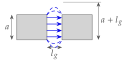
Apply Eq. (4.3.27) and compare the two reluctances. The flux of a gap-dominated circuit is , so it moves inversely to .
and :
: the uncorrected reluctance is too high, equivalently is below . If the gap dominates, is under-estimated by the same , i.e. the true flux is larger.
gives , so . The "add to each side" rule is an empirical fit valid for . At it is already rough, and for the field spreads over a region comparable with the pole and the gap can no longer be treated as a lumped reluctance: one has to compute the field, or measure it.
, the of (b). Fringing always makes the gap better than the simple formula says, so an inductor designed with comes out with a few per cent more inductance than planned. Designers either accept the correction or, for precision, split the gap into several short ones so that for each.