Section 4.3 · Further exercises · 4 of 10
Exercise 4.3.4: Two coils on a three-limb core (linear)
About the further exercises of Section 4.3
Ten further exercises in the spirit of Problems 4.3.1–4.3.3, the applications and the home exercises. They use only
Where a material is nonlinear the – curves of Figure 4.3.19 are used, with the readings given in the statement. Exercises 4.3.1–4.3.4 are about reluctance, flux and inductance, Exercises 4.3.5–4.3.6 about transformers and motors, and Exercises 4.3.7–4.3.10 about recording heads, electromagnets, fringing and leakage. Constant: .
Two coils on a three-limb core (linear)
#cf. Problem 4.3.2 and the two-loop circuit
A three-limb core of uniform cross-section and has outer limbs of mean path (each measured from the top node to the bottom node) and a centre limb . Coil 1 (, ) sits on the left limb and coil 2 (, ) on the right limb, both driving flux upwards in their own limb. Find the flux in each limb and the induction in the centre limb.
Adapted from: D. K. Cheng, Field and Wave Electromagnetics, 2nd ed., Example 6-11.
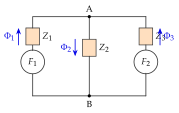
This is the two-loop circuit of Section 4.3.2 with linear reluctances: one node equation and two loop equations (4.3.13)–(4.3.14), solved as a pair of linear equations.
, so
Take and upward in the outer limbs and downward in the centre limb. At node A, . The mmfs are and . Loop 1 (left limb and centre limb) and loop 2 (right limb and centre limb):
In numbers (): and . Subtracting the second from the first, , so . Adding them, , so . Hence
Loop 1: , i.e. (units ). Loop 2: , i.e. . The right coil barely drives any flux through its own limb: its are almost cancelled by the potential difference that coil 1 imposes across the centre limb. Had been (), would have been zero, the magnetic version of a bridge balance. The result is unphysical for real iron (): the linear model happily gives it, which is the warning of Section 4.3.6. With a real curve the centre limb would saturate and the fluxes would be redistributed.