Section 4.3 · Problems · 1 of 3
Problem 4.3.1: Two C-cores with two air gaps
Two C-cores with two air gaps
#What should be the width of the air gap, namely , such that the magnetic induction field in this gap will have an intensity of (, , , , , , sheet steel, cast iron, cross-sectional areas are assumed to be equal on each branch)? (Permeability of air may be taken as .)
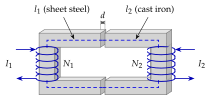
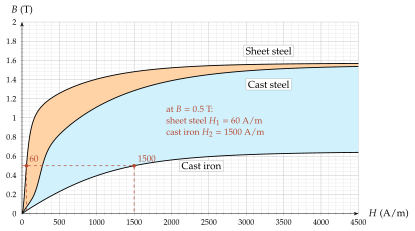
The two C-cores and the two gaps form one closed flux tube, so the same flux , and since all cross-sections are equal the same , is carried by the sheet steel, the cast iron and both gaps. Ampère's law round the mean path then has four terms on the left and the two magnetomotive forces on the right. The iron terms are found by reading at from the two curves, and the gap term is .
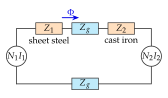
In series: (sheet steel, ), , (cast iron, ) and again, with the two sources and driving the flux the same way round (Figure 4.3.20a). The flux crosses the gap twice.
Sheet steel: , so . Cast iron: , so . In the gaps , and the flux crosses a gap twice: .
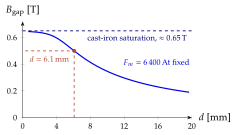
The tool reads both curves at 0.5 T and returns mm. Switch to 'Given d → find B' and shrink to see the cast-iron ceiling near 0.65 T.
Back into the loop: . Units: in A/m times in m gives A, and is . Of the , () are spent on of air and only on of iron, and of those on the cast iron, whose permeability at is , i.e. , against for the sheet steel. The cast iron also sets a ceiling (Figure 4.3.20b): its curve flattens near , so however small is made, the gap induction cannot exceed about with this mmf.