Section 4.3 · Home exercises · 3 of 3
Home exercise 4.3.3: Lifting electromagnet
About the home exercises of Section 4.3
In the home exercises the material is treated as linear (), so each branch has a definite reluctance , and .
Lifting electromagnet
#A U-shaped electromagnet with turns is to lift a steel plate of mass . Each of the two pole faces has an area of , the mean iron path (magnet and plate together) is with , and there is an air gap of under each pole. Take , , and neglect fringing and leakage. (a) Using per gap, find the induction in the gaps needed to hold the plate. (b) Find the mmf required and the current . (c) How does the required current change if the plate is held at per pole?
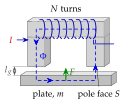
Work backwards from the load: the weight fixes the pull, the pull fixes in the gaps (Application 4.3.2), and the loop rule with one iron path and two gaps in series then fixes .
The plate hangs from two pole faces, each pulling with , so the total force is . It must equal the weight :
Loop rule round the flux path, one iron path and two gaps in series (equal area everywhere, so is the same in iron and gap):
With the gap term doubles, , while the iron term stays :
Read off T, At and A, then drag the plate to 1 mm.
Units: is . Even at the two gaps take of the mmf, and the of iron () are worth only of air. Conversely, at a fixed current the induction, and with it the force , collapses as the gap opens: with at one gets and , less than a third of the weight. A lifting magnet therefore needs clean, flat contact, and a safety factor in the current.