Section 4.3 · Topic 4 of 10
4.3.4 Reluctances in series and in parallel
Series
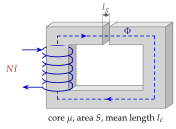
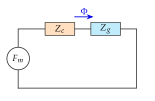
Figure 4.3.5 shows a core with a short air gap of length cut into it. There is one flux tube: the same flux crosses the iron (mean length , permeability , area ) and the gap (length , permeability , the same area when fringing is neglected). Ampère's law around the mean path has two terms on the left,
so the magnetic potential drops add, and with them the reluctances.
Set the gap to zero and then to 1 mm: the two drops in the bar always add up to , and the flux follows .
Branches carrying the same flux are in series. Their reluctances add:
Parallel
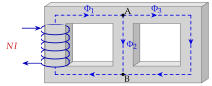
In the three-limb core of Figure 4.3.6 the flux driven around the left window arrives at the corner A and divides: goes down the central limb and goes round the right window. The node rule at A gives . Both branches start at A and end at B, so Ampère's law around the right window (which links no current) gives : the two branches have the same magnetic potential difference . Eliminating and ,
Branches spanning the same pair of nodes are in parallel. Their reluctances combine like parallel resistors, and the whole circuit of Figure 4.3.6 has
The flux divides in inverse proportion to the reluctances: most of it takes the easier path.
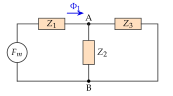
The loop rule around every closed path of the circuit is written branch by branch. The node rule at every node is for a closed surface wrapped around the node. Series and parallel combinations, mesh equations and the whole of circuit theory follow from these two, as they do from Kirchhoff's two laws in electric circuits.
- Draw the mean flux path through every branch, mark the nodes where the iron branches, and give each branch its length , area and material.
- Draw the equivalent circuit: a reluctance per branch, an mmf source in the branch that carries a winding (with the direction given by the right-hand rule), and the nodes.
- If the material is linear, compute for every branch, with in air gaps, and solve the network with series and parallel rules or mesh equations.
- If the material is nonlinear, work with and instead of : start in the branch where or is given, read off the – curve, write for the potential drop of each iron branch and for each gap, and use the loop and node rules to move to the next branch (Section 4.3.6 and Problems 4.3.1–4.3.3).
- Check: every loop must balance to its , and the fluxes must balance at every node.
Two identical outer loops of reluctance each hang in parallel on a central limb of reluctance that carries the winding. What reluctance does the winding see, and how does the flux divide?
, and by symmetry each outer loop takes half of the flux of the central limb (Home exercise 4.3.2).