Section 4.3 · Problems · 3 of 3
Problem 4.3.3: Series-parallel core with a gap in the centre limb
Series-parallel core with a gap in the centre limb
#In the magnetic circuit below, calculate the required current to be passed in the coil having turns in order to establish a flux of in the air gap. Neglect fringing effect and leakage flux. The – curve of the material is given in the figure. (Permeability of air may be taken as .) (, , , cross-sectional areas at branches 1 and 4 , cross-sectional areas at branches 2 and 3 and the air gap .)
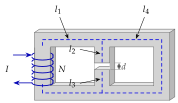
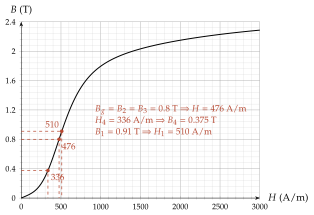
Branch 1 (the limb with the coil) carries the whole flux. At its ends the circuit splits into the centre path (, gap, ) and the outer path (), which are in parallel: they span the same magnetic potential difference . Start where the data are, at the gap flux, and go upstream: from the centre path, from the outer path, from the node, from the loop through branch 1.
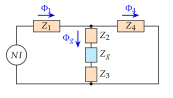
. Branches 2 and 3 have the same area as the gap and carry the same flux, so , for which the curve gives . In the gap . Hence
Branch 4 spans the same : , and the curve gives , so
, so and, from the curve, .
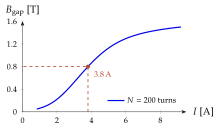
Check the three readings and the flux split, then switch to 'Given I' and vary the current.
The other loop, branch 1 and branch 4: . Here the iron dominates, not the gap: of air costs only out of . The parallel branch is not a detail. It carries , of what the coil must push, and ignoring it (, , ) would give , , that is too little. Notice also that steps 1–4 never used a value of : for a nonlinear material one works with and read from the curve, and is only a bookkeeping device.