Section 4.3 · Topic 5 of 10
4.3.5 The air gap
Almost every useful magnetic circuit has an air gap: a motor needs one so that the rotor can turn, a lifting magnet has one under each pole, a recording head writes through one, and an energy-storing inductor is given one on purpose. The gap is always short. Why does it matter so much?
Take the gapped core of Figure 4.3.7a, with an iron path of length and relative permeability , and a gap of length . Core and gap carry the same flux, so their reluctances add, Eq. (4.3.17), and their ratio is
The ratio of the lengths is multiplied by , which is in the thousands.
The gap and the iron have equal reluctance when
that is, a millimetre of air is worth millimetres of iron. For and this happens at .
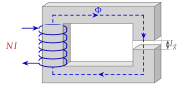
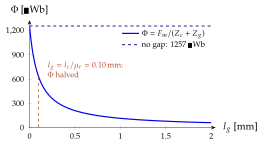
Figure 4.3.7b puts numbers to this. The iron path of a silicon-steel C-core, long with and , has . One millimetre of air in the same cross-section has , ten times as much. With the flux falls from without a gap to about with the millimetre gap. Two practical consequences follow.
- In a gapped circuit one may often neglect the iron altogether to first order: the flux is and the gap field is . Problem 4.3.1 and Home exercise 4.3.3 show the gap taking three quarters of the mmf.
- A gap one does not want hurts just as much. A burr or a grain of dust in a butt joint of a laminated core halves the flux of the example, and a transformer core is stacked with interleaved laminations precisely to avoid such joints.
Flux "sees" a millimetre of air as millimetres of iron. In most gapped circuits the gap sets the flux and the iron is a short circuit, which is both a nuisance (unwanted gaps) and a design tool (wanted gaps, Section 4.3.7).
A ring of and mean length is cut open by . By what factor does the flux fall at constant current?
, so grows by the factor and the flux falls by . Home exercise 4.3.1 gives the full numbers.