Section 4.3 · Further exercises · 6 of 10
Exercise 4.3.6: Torque of a reluctance machine
About the further exercises of Section 4.3
Ten further exercises in the spirit of Problems 4.3.1–4.3.3, the applications and the home exercises. They use only
Where a material is nonlinear the – curves of Figure 4.3.19 are used, with the readings given in the statement. Exercises 4.3.1–4.3.4 are about reluctance, flux and inductance, Exercises 4.3.5–4.3.6 about transformers and motors, and Exercises 4.3.7–4.3.10 about recording heads, electromagnets, fringing and leakage. Constant: .
Torque of a reluctance machine
#cf. Application 4.3.1
The inductance of the excited phase of a reluctance motor varies with the rotor angle as with , (: rotor tooth aligned with the pole). The phase carries a constant current . (a) Find the torque and its maximum. (b) At which angle is the torque zero, and which of these positions is stable? (c) How much mechanical work is done when the rotor moves from the unaligned to the aligned position at constant current, and how much energy does the source supply during that motion?
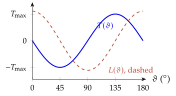
The torque at constant current is , Eq. (4.3.29). Work is the integral of the torque, and the source supplies that work plus the change of stored energy.
With and the current held constant,
at (aligned) and (unaligned). For a small displacement from the torque is restoring (negative for ): aligned is stable. At it drives the rotor away: unstable. The torque does not depend on the sign of , the rotor is always pulled to minimum reluctance.
Work done by the torque from to :
The stored energy rises by as well, so the source must supply (it works against the induced emf ).
Units: , and a torque in J per radian is a torque in . At constant current exactly half of what the source delivers becomes mechanical work, and the other half is stored in the field, the same "one half" as for the constant-voltage dielectric slab of Section 3.4. In a motor the current is switched off at the aligned position, the stored is returned to the supply, and the phase is re-energised when the next tooth approaches: net of work per stroke, strokes per revolution for a machine, i.e. per revolution average torque.