Section 4.3 · Home exercises · 2 of 3
Home exercise 4.3.2: Series-parallel core
About the home exercises of Section 4.3
In the home exercises the material is treated as linear (), so each branch has a definite reluctance , and .
Series-parallel core
#The three-limb core in the figure has a coil of turns carrying on its centre limb. The centre limb has a mean length , and each outer loop (centre limb excluded) has a mean length . All limbs have the same cross-section , the material has , and there is no air gap. Take and neglect leakage. (a) Draw the equivalent circuit and find the reluctance seen by the coil. (b) Find the flux in the centre limb and in each outer limb, and the induction in each.
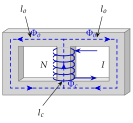
The centre limb carries the mmf and feeds two identical outer loops that hang between the same two nodes: a series reluctance followed by two equal reluctances in parallel. Symmetry then shares the flux equally between the outer loops.
The centre limb (reluctance , source ) feeds two identical outer loops ( each) connected in parallel between the top and bottom nodes (Figure 4.3.25). With ,
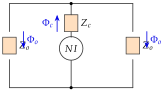
, so
by symmetry (equal reluctances share the flux equally). Dividing by :
Loop through the centre limb and one outer loop: . The two outer loops behave as one loop of half the reluctance, the parallel rule of Section 4.3.4. The centre limb carries twice the flux of an outer limb with the same area, which is why the centre limb of a real E-core is made twice as wide: then is the same everywhere and no part saturates first.