Section 4.3 · Further exercises · 8 of 10
Exercise 4.3.8: Lifting magnet at a given current
About the further exercises of Section 4.3
Ten further exercises in the spirit of Problems 4.3.1–4.3.3, the applications and the home exercises. They use only
Where a material is nonlinear the – curves of Figure 4.3.19 are used, with the readings given in the statement. Exercises 4.3.1–4.3.4 are about reluctance, flux and inductance, Exercises 4.3.5–4.3.6 about transformers and motors, and Exercises 4.3.7–4.3.10 about recording heads, electromagnets, fringing and leakage. Constant: .
Lifting magnet at a given current
#cf. Application 4.3.2 and Home exercise 4.3.3
A U-shaped electromagnet has turns carrying . Each of its two pole faces has , and it is held from a thick steel plate. Neglect the reluctance of the iron, fringing and leakage. (a) Find in the gaps and the total pull on the plate. What mass can it hold? (b) Repeat for . (c) Sketch : how does the force scale with the gap at fixed current, and why is this different from the rule at fixed flux?
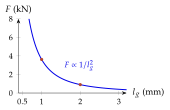
With ideal iron the whole mmf is spent on the two gaps, , which fixes . Then the pressure on each face gives the force.
The whole mmf is spent on the two gaps in series, , so
Each pole pulls with , two poles:
halves to and quarters the force: , .
At fixed current , hence
At fixed flux (a permanent magnet, or a coil whose current is adjusted to keep ) the force per pole is independent of . With a coil at fixed current the flux itself collapses as the gap opens, which is what makes the force fall so steeply, and what makes the magnet "snap" onto the plate as the gap closes.
1 mm gives 3.6 kN, 2 mm a quarter of it.
Units: is . at is near the saturation of ordinary steel, so in reality the iron would start to take a share of the mmf and the force would be somewhat less. The law holds while the iron stays far from saturation. Compare with Home exercise 4.3.3, where the iron path cost of the mmf at .