Section 4.3 · Further exercises · 5 of 10
Exercise 4.3.5: Designing a small transformer
About the further exercises of Section 4.3
Ten further exercises in the spirit of Problems 4.3.1–4.3.3, the applications and the home exercises. They use only
Where a material is nonlinear the – curves of Figure 4.3.19 are used, with the readings given in the statement. Exercises 4.3.1–4.3.4 are about reluctance, flux and inductance, Exercises 4.3.5–4.3.6 about transformers and motors, and Exercises 4.3.7–4.3.10 about recording heads, electromagnets, fringing and leakage. Constant: .
Designing a small transformer
#cf. the transformer subsection
A , transformer is to be built on a laminated core of cross-section , mean length , , with the induction limited to . (a) How many primary turns are needed? (b) How many secondary turns for ? (c) Find the magnetising inductance and the rms magnetising current. (d) How would and change at ?
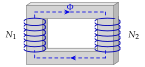
The transformer equation (4.3.25) fixes the turns from the voltage and the allowed , the turns ratio (4.3.23) fixes the secondary, and the core reluctance gives the magnetising inductance (4.3.24).
With a sinusoidal flux Faraday's law gives , so
, so turns (giving at no load).
and
At the same and need only turns. Then and , larger, because fell by while rose by . In practice one keeps more turns than the minimum, or a smaller core: at the core can be times smaller for the same , which is the point of aircraft power.
Via the circuit: needs , i.e. , rms as in (c). This is a few per cent of a typical full-load current for a core of this size, the price of the finite . One badly stacked joint, say an effective gap (), would raise by and to .