Section 4.3 · Further exercises · 2 of 10
Exercise 4.3.2: Gapped inductor and where its energy sits
About the further exercises of Section 4.3
Ten further exercises in the spirit of Problems 4.3.1–4.3.3, the applications and the home exercises. They use only
Where a material is nonlinear the – curves of Figure 4.3.19 are used, with the readings given in the statement. Exercises 4.3.1–4.3.4 are about reluctance, flux and inductance, Exercises 4.3.5–4.3.6 about transformers and motors, and Exercises 4.3.7–4.3.10 about recording heads, electromagnets, fringing and leakage. Constant: .
Gapped inductor and where its energy sits
#cf. the air-gap subsection
A ferrite core, mean iron length , , , carries turns and has an air gap . (a) Find , and the inductance , and compare with the inductance of the same core without the gap. (b) For find , the stored energy, and the fractions of the energy stored in the gap and in the ferrite. (c) Up to what current may the coil be used if the ferrite saturates at , with and without the gap?
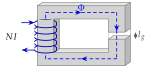
Core and gap in series. The energy splits in the ratio of the reluctances, so the gap, which holds most of the reluctance, holds most of the energy.
:
Half a millimetre of air has ten times the reluctance of of ferrite. In series and
, (the same in core and gap, equal areas). . The energy splits like the reluctances, because :
reaches at : with the gap , without the gap only .
With densities: in gives , in gives , total as in (b). The gap lowers by times but raises the usable current by times, so the maximum storable energy is times larger: against . Energy-storage inductors (switch-mode converters, flyback transformers) always have a gap, and nearly all their energy sits in it. Note that at the gapped core would in fact be slightly saturated (): a reminder that part (b) assumes the linear model.