Section 4.3 · Further exercises · 10 of 10
Exercise 4.3.10: Leakage put into the circuit
About the further exercises of Section 4.3
Ten further exercises in the spirit of Problems 4.3.1–4.3.3, the applications and the home exercises. They use only
Where a material is nonlinear the – curves of Figure 4.3.19 are used, with the readings given in the statement. Exercises 4.3.1–4.3.4 are about reluctance, flux and inductance, Exercises 4.3.5–4.3.6 about transformers and motors, and Exercises 4.3.7–4.3.10 about recording heads, electromagnets, fringing and leakage. Constant: .
Leakage put into the circuit
#cf. the fringing and leakage subsection
A C-core with a gap is driven by . The core reluctance is , the gap reluctance , and the leakage path across the window is a reluctance in parallel with the gap. (a) Draw the circuit and find the coil flux, the gap flux and the leakage flux. (b) Find the leakage coefficient . (c) How much extra mmf is needed to restore the gap flux to the no-leakage value? (d) Compare with the gap flux a designer would predict by ignoring leakage altogether.
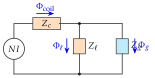
A series-parallel network: in series with the parallel pair . The coil flux follows from the total reluctance, the magnetic potential across the pair divides it between gap and leakage.
, total :
(equivalently ).
Without leakage . To get in the gap with leakage present the coil must carry , and : only () more, because the leakage flux flows through the low-reluctance core only.
Ignoring leakage predicts in the gap. The real value is , less, but the core carries more flux than predicted, which is where the error bites: the core section must be sized for , not for .
Node: . Loop through and : . Fringing (Exercise 4.3.9) and leakage err in opposite directions on the gap flux, but leakage has a second effect fringing does not: it loads the core. A leakage coefficient of to is typical of gapped cores. It falls when the coil is placed on the gapped limb and when the window is wide compared with the gap. In transformers the same flux shows up as the leakage inductances and .