Section 3.2 · Topic 2 of 7
3.2.2 Outward flux of the field of a point charge
We now compute the central quantity of this section: the outward flux of of a single point charge through a closed surface. We start with a sphere centred on the charge, where everything is simple, and then say what happens for any other closed surface around the charge.
A sphere centred on the charge
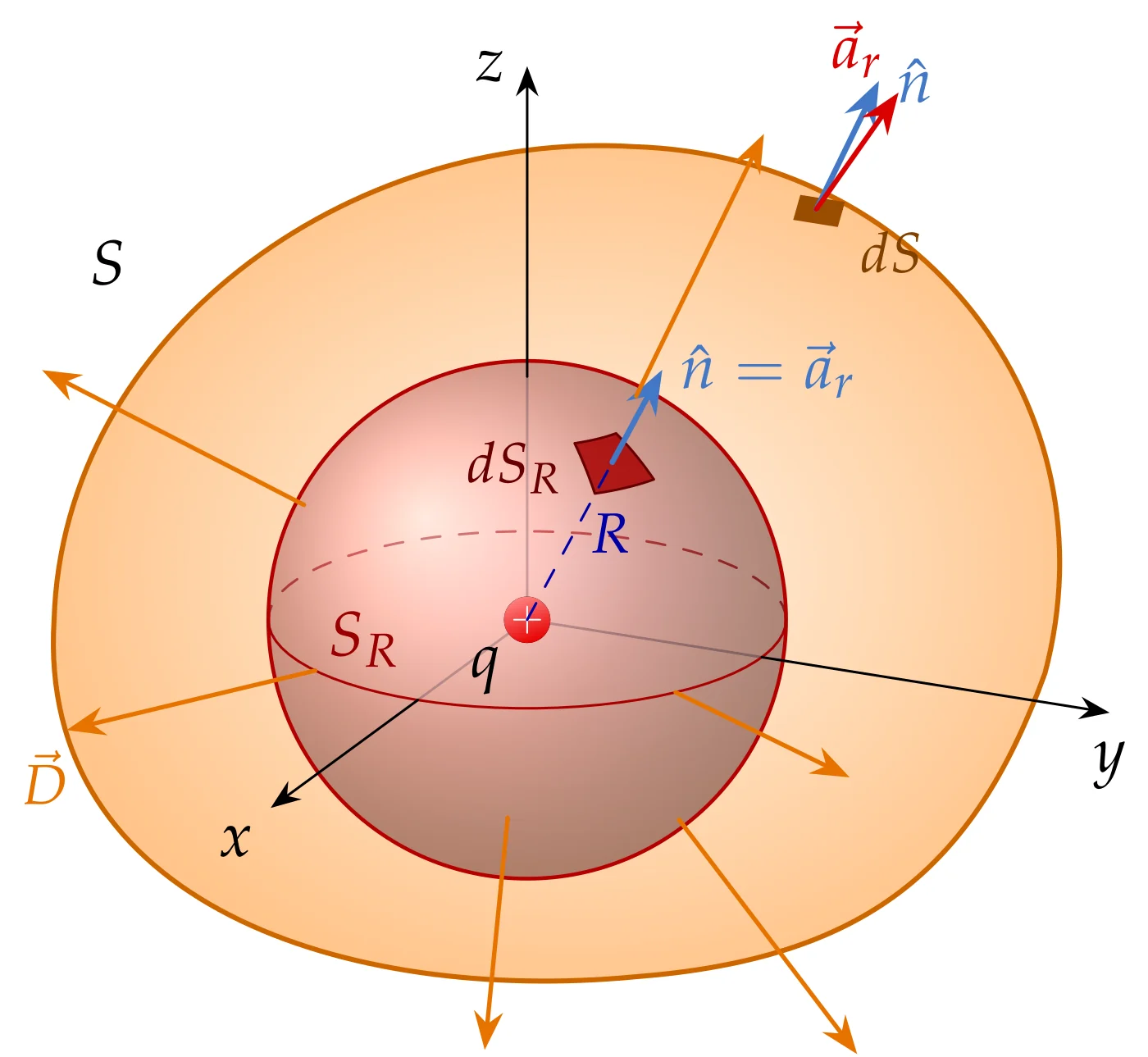
Let the charge sit at the origin, and let be the sphere of radius centred on it (Figure 3.2.4a). On :
- the outward normal is , the same direction as ,
- the magnitude of is the same at every point, , because every point of is at the same distance from the charge, and
- the surface element of a sphere of radius in spherical coordinates (Section 2.3) is the little curved rectangle of sides (along a meridian) and (along a circle of latitude, whose radius is ), Figure 3.2.4b:
Since ,
and the radius has cancelled. Integrating over the whole sphere ( from to , from to ),
The outward flux through the sphere is exactly , whatever its radius. This is the precise version of the picture of Figure 3.2.1: the factor of Coulomb's law is cancelled by the factor of the area.
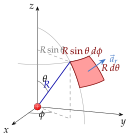
Writing on a sphere. Then the flux comes out as , which depends on and even has the wrong unit. The element of a sphere of radius is : both factors and the factor (the circles of latitude shrink towards the poles) are essential.
What is the flux of of a point charge at the origin through the upper hemisphere () of a sphere centred on it?
, as symmetry demands: half of the lines go up, half go down.
Any closed surface around the charge
The same result holds for an arbitrary closed surface around the charge (Figure 3.2.4a). The field lines of begin on the charge and never end in empty space, so the lines that cross are exactly the lines that cross the small sphere . The outward flux through is therefore the same as through , namely :
If the charge lies outside , every line that enters also leaves it, and the net flux is zero.
Wrap a charge in any closed surface you like, small or large, round or crumpled: exactly coulombs of flux come out. Wrap a surface beside the charge: whatever flows in, flows out again.
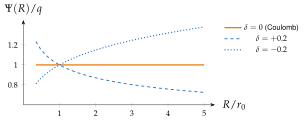
The argument used only two properties of the field (3.2.1): it is radial, and it falls off as . The is cancelled exactly by the growth of the area of a sphere. If the force between charges fell off as with , the flux through a sphere would depend on its radius (Figure 3.2.5) and Gauss's law would fail. Gauss's law is therefore not an extra assumption: it is Coulomb's law, rewritten.
A charge lying exactly on is neither inside nor outside, and the surface then catches only a part of its flux, as Exercise 3.2.8 shows for a charge at the corner of a cube. In practice we always choose surfaces that do not pass through point charges.
A point charge sits at the centre of a cube. What is the flux of through one face?
The flux through the whole cube is . The six faces are identical as seen from the centre, so each carries (Exercise 3.2.8).