Section 3.2 · Further exercises · 3 of 10
Exercise 3.2.3: A uniformly charged slab
About the further exercises of Section 3.2
Ten further exercises in the spirit of Problems 3.2.1–3.2.5 and the home exercises. All of them use Gauss's law in its integral or differential form,
together with symmetry and, where useful, superposition. Exercises 3.2.1–3.2.2 have cylindrical symmetry, Exercises 3.2.3–3.2.4 planar symmetry, and Exercises 3.2.5–3.2.9 spherical symmetry (or a symmetry argument of another kind), while Exercise 3.2.10 checks the law for a field without any symmetry.
A uniformly charged slab
#cf. Problem 3.2.3
An infinite slab carries a uniform volume charge density . By using Gauss's law, find inside and outside the slab.
Adapted from: B. M. Notaroš, Electromagnetics, Problem 1.61.
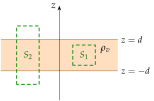
Planar symmetry, as for the sheet of Problem 3.2.3, so a pillbox symmetric about the mid-plane: with its faces inside the slab it encloses a slab of thickness , with its faces outside the full thickness .
By symmetry the field is along , depends only on , and (the plane is a plane of mirror symmetry), exactly as for the sheet of Problem 3.2.3.
Take a pillbox of face area with its faces at . The flux through the side is zero and both faces contribute , while the enclosed slab has thickness :
A pillbox with faces at encloses the full thickness , i.e. the charge :
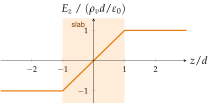
The field is zero in the mid-plane, grows linearly through the slab and is continuous at (Figure 3.2.27). Outside, the slab is equivalent to a single sheet , whose field is (Problem 3.2.3). In Exercise 3.3.8 the same field will be obtained by solving Poisson's equation. Gauss's law needs no boundary conditions here because symmetry supplies them.