Section 3.2 · Further exercises · 10 of 10
Exercise 3.2.10: Checking Gauss's law on a cube
About the further exercises of Section 3.2
Ten further exercises in the spirit of Problems 3.2.1–3.2.5 and the home exercises. All of them use Gauss's law in its integral or differential form,
together with symmetry and, where useful, superposition. Exercises 3.2.1–3.2.2 have cylindrical symmetry, Exercises 3.2.3–3.2.4 planar symmetry, and Exercises 3.2.5–3.2.9 spherical symmetry (or a symmetry argument of another kind), while Exercise 3.2.10 checks the law for a field without any symmetry.
Checking Gauss's law on a cube
#cf. the divergence theorem
In free space . Find the total charge inside the cube (a) from the differential form , (b) by computing the outward flux through the six faces.
This field has no symmetry, so we use Gauss's law to check, not to find: compute the enclosed charge from , and independently the flux face by face with outward normals.
Face by face, with outward normals (Figure 3.2.32):
- (): , flux , (): , flux .
- (): , flux , (): again, flux .
- and : , flux .
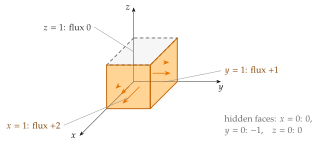
This field has no symmetry, so Gauss's law cannot be used to find it, but it still holds, and both sides agree. Gauss's law always holds, although it is only useful for computing when symmetry makes constant on the surface.