Section 3.2 · Further exercises · 5 of 10
Exercise 3.2.5: Concentric charged spherical shells
About the further exercises of Section 3.2
Ten further exercises in the spirit of Problems 3.2.1–3.2.5 and the home exercises. All of them use Gauss's law in its integral or differential form,
together with symmetry and, where useful, superposition. Exercises 3.2.1–3.2.2 have cylindrical symmetry, Exercises 3.2.3–3.2.4 planar symmetry, and Exercises 3.2.5–3.2.9 spherical symmetry (or a symmetry argument of another kind), while Exercise 3.2.10 checks the law for a field without any symmetry.
Concentric charged spherical shells
#cf. Problem 3.2.5
Two concentric spherical surfaces of radii and () carry total charges and , each uniformly distributed. Find everywhere and the surface charge densities. For which is there no field outside?
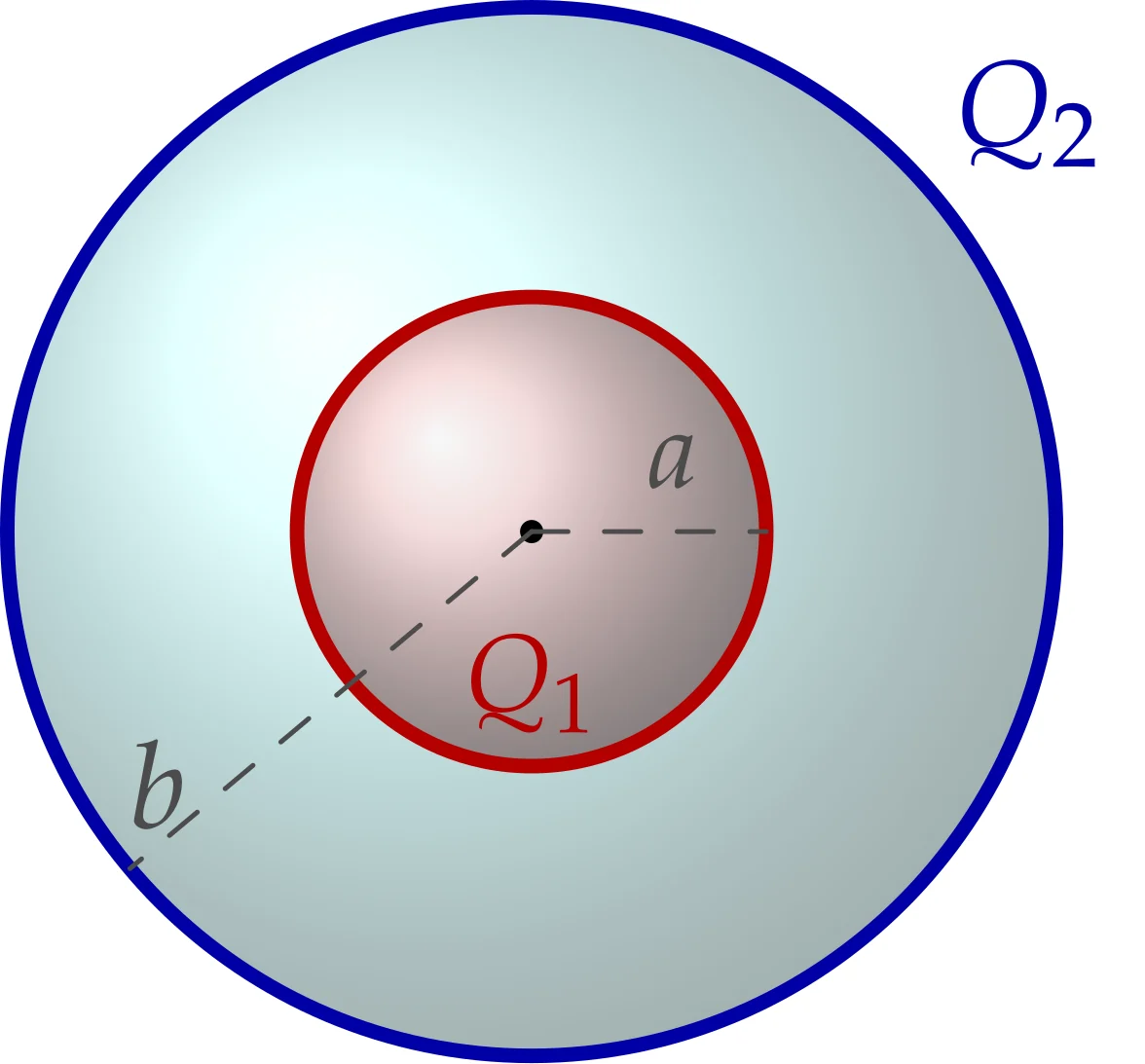
Spherical symmetry and a concentric Gaussian sphere in each of the three regions. Each shell's charge counts once the Gaussian sphere encloses it.
On a concentric Gaussian sphere of radius , . The enclosed charge is for , for and for . Each charge is spread uniformly over the area or . Hence
There is no field outside when : the arrangement is then a spherical capacitor, with the whole field confined between the shells.
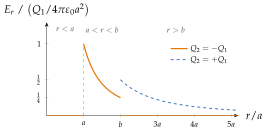
At each shell the field jumps by . For instance, at , (Figure 3.2.29). The conducting shell of Worked example 3.2.2 is a related case in which the surface charges are induced: on the inner face and on the outer face of the shell.