Section 3.2 · Further exercises · 9 of 10
Exercise 3.2.9: A uniform field inside a cavity
About the further exercises of Section 3.2
Ten further exercises in the spirit of Problems 3.2.1–3.2.5 and the home exercises. All of them use Gauss's law in its integral or differential form,
together with symmetry and, where useful, superposition. Exercises 3.2.1–3.2.2 have cylindrical symmetry, Exercises 3.2.3–3.2.4 planar symmetry, and Exercises 3.2.5–3.2.9 spherical symmetry (or a symmetry argument of another kind), while Exercise 3.2.10 checks the law for a field without any symmetry.
A uniform field inside a cavity
#cf. Home exercise 3.2.1
A sphere of radius carries a uniform volume charge density , except for a spherical cavity of radius whose centre is displaced by the vector from the centre O of the sphere (the cavity lies entirely inside the sphere). Show that the field inside the cavity is uniform and find it.
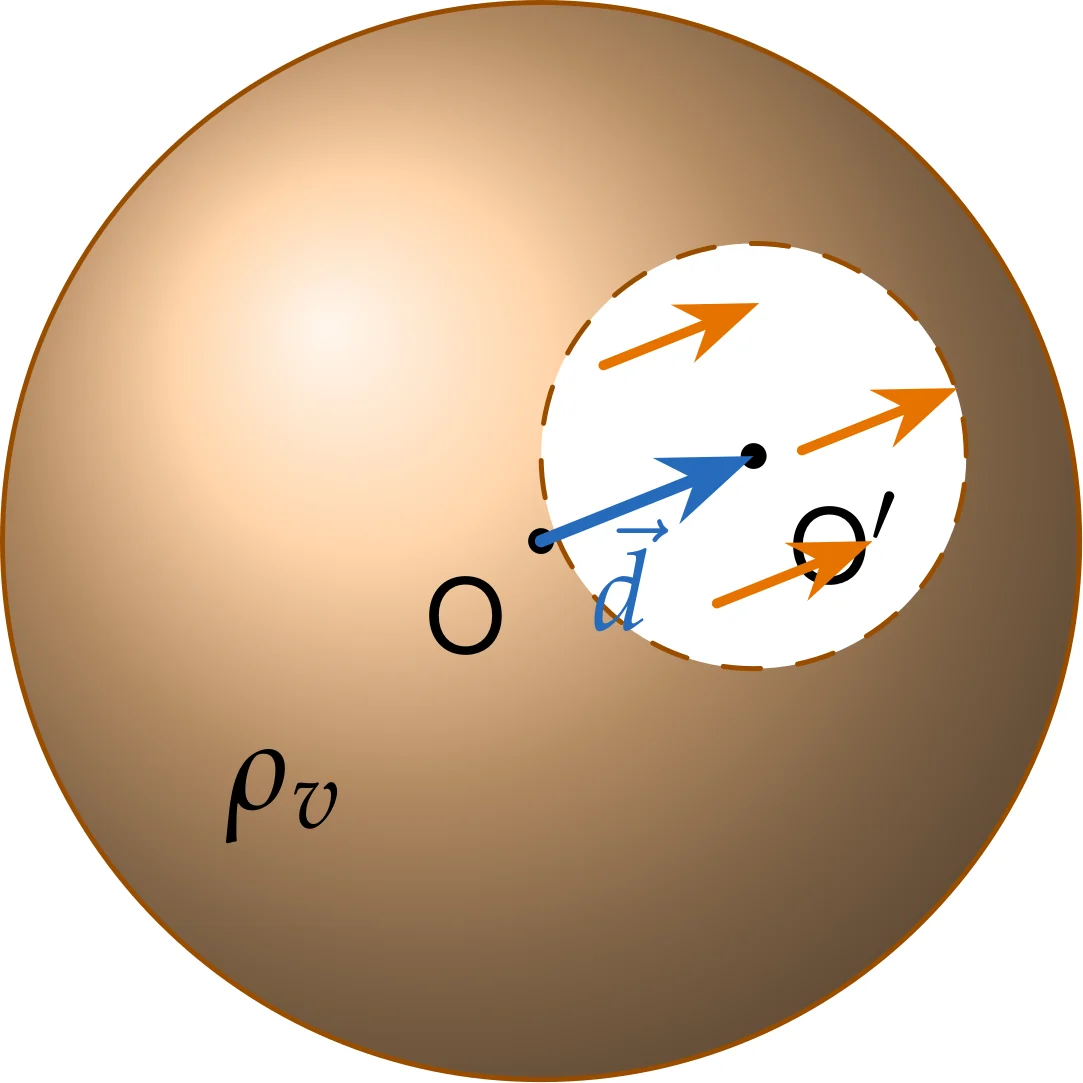
The sphere with an off-centre cavity has no symmetry of its own, but it is the sum of two symmetric problems: a full sphere of density and a small sphere of density filling the cavity. Gauss's law gives the field inside each, and superposition does the rest.
From Home exercise 3.2.1, with , the field at a point with position vector measured from the centre is
The charged sphere with a cavity is equivalent to a full sphere of density (centre O) plus a small sphere of density filling the cavity (centre ): in the cavity the two densities cancel, elsewhere only remains. For a point P inside the cavity, with measured from O and measured from , P is inside both spheres, and
(the same at every point of the cavity)
The field in the cavity is uniform, parallel to the line joining the two centres, and independent of the sizes and . For a concentric cavity () it vanishes, as Problem 3.2.5 showed. The same argument for an infinite cylinder with an off-axis cylindrical hole, using Home exercise 3.2.3, gives . Note that the sphere with a cavity has no symmetry that would allow Gauss's law to be applied directly: superposition of two symmetric problems does the job.