Section 3.2 · Home exercises · 1 of 3
Home exercise 3.2.1: Uniformly charged sphere
Uniformly charged sphere
#A sphere of radius carries a total charge , distributed uniformly throughout its volume. By using Gauss's law, find the electric field in the regions and . Sketch as a function of . Where is it largest?
Source: B. M. Notaroš, Electromagnetics, Example 1.18.
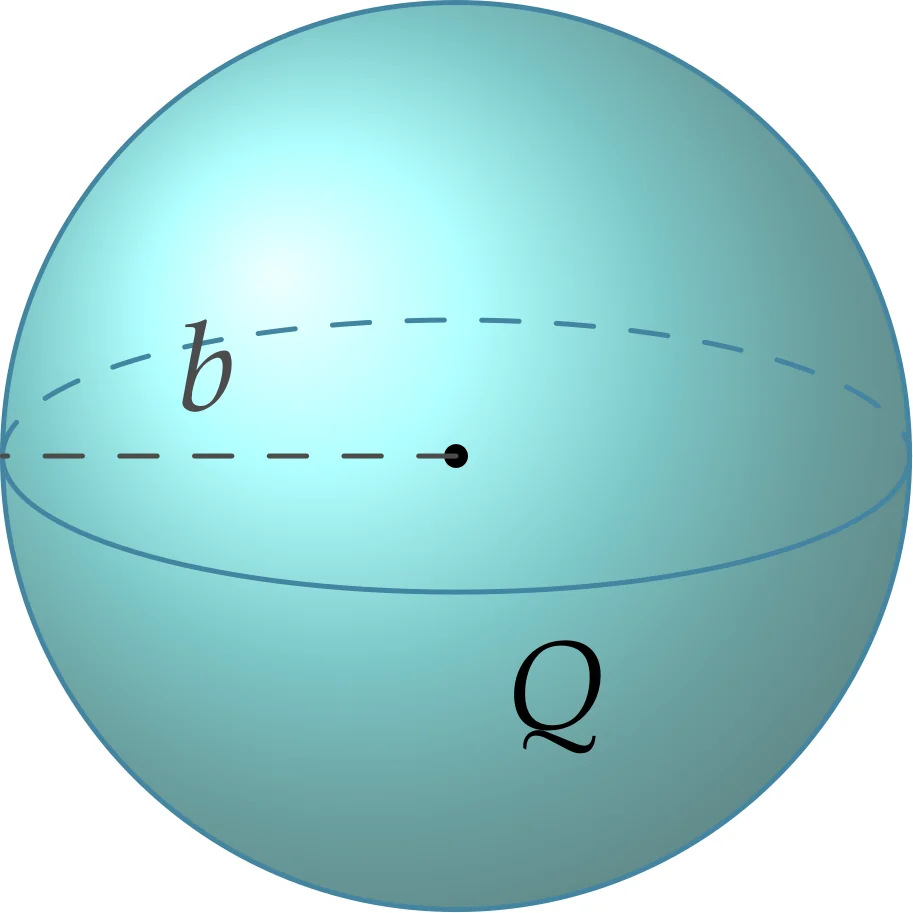
Spherical symmetry and a concentric Gaussian sphere, as in Problem 3.2.5. Inside the ball the sphere encloses only the fraction of the charge, because the charge is uniform.
The charge distribution is spherically symmetric, so . For the left-hand side of Eq. (3.2.13) we take a concentric sphere of radius . As in Problem 3.2.5,
to give
The charge is uniform, so the enclosed fraction of is the volume fraction:
Equating both sides, , which gives
The Gaussian sphere encloses the whole charge,
which gives
grows linearly from zero at the centre to its largest value at the surface , where the two expressions agree, and then decreases as (Figure 3.2.23).
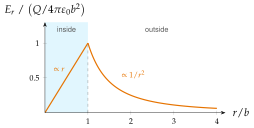
Vary the radius and the charge below: the field always rises linearly to its maximum at the surface and then falls as .
Both expressions give at (no surface charge, no jump), and at the centre, where by symmetry no direction is preferred. Outside, the sphere acts like a point charge at its centre. The result is Problem 3.2.5 with and : indeed . In vector form the field inside is , a form used in Exercise 3.2.9.