Section 3.2 · Home exercises · 2 of 3
Home exercise 3.2.2: Nonuniformly charged sphere
Nonuniformly charged sphere
#A sphere of radius carries the volume charge density
where is a constant. (a) Find the total charge of the sphere. (b) By using Gauss's law, find the electric field in the regions and .

The density depends on only, so the symmetry is still spherical and the concentric Gaussian sphere works. The only new element is that the enclosed charge must be found by integrating , because with a density that varies with we cannot simply multiply by a volume.
The total charge is the volume integral of the density over the sphere, with :
The distribution is spherically symmetric and . For the left-hand side of Eq. (3.2.13), exactly as in Home exercise 3.2.1,
For the right-hand side, we can write for (primed variables for the integration inside the Gaussian sphere)
and equating both sides, , which gives
For the Gaussian sphere encloses the whole charge,
which gives
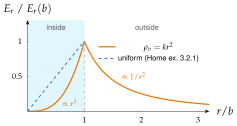
Change and the radius below and watch the rise inside and the fall outside.
Both expressions give at : the field is continuous, as it must be without surface charge. Units: is in , so is in . Because the charge is concentrated towards the surface, little charge is enclosed at small and the field rises as (Figure 3.2.24). A check with the differential form of Gauss's law in spherical coordinates: