Section 3.2 · Problems · 3 of 5
Problem 3.2.3: Infinite planar surface charge
Infinite planar surface charge
#Find the electric field at a normal distance above an infinite planar surface carrying a uniform surface charge density of by using Gauss's law.
Source: D. K. Cheng, Field and Wave Electromagnetics, 2nd ed., Example 3-6.
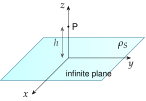
An infinite plane has planar symmetry: the field is normal to the plane, depends only on the distance from it and points away from it on both sides. A pillbox cut in half by the plane collects flux through both faces and none through its side.
The infinite plane is unchanged by any translation in or and by any rotation about a normal, so the field can depend on only and can have no component parallel to the plane: . Moreover is a mirror plane of the charge distribution: the field at is the mirror image of the field at , so . For the field points away from the plane on both sides and has the same magnitude at .
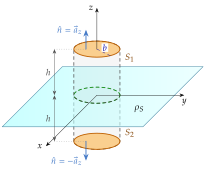
For the left-hand side we take a cylindrical "pillbox" of radius ( to be taken to infinity later) whose top face is at and whose bottom face is at (Figure 3.2.19). On
with constant on , and on
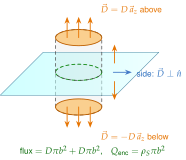
so the two faces contribute equally (two minus signs make a plus). On the side of the pillbox , so it contributes nothing.
(Each face gives , the field times the face area.)
The pillbox cuts a disk of radius out of the charged plane:
Equating both sides,
The radius has cancelled, so has no effect on the result, and we find
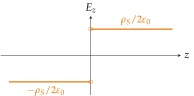
The distance has dropped out: the field of an infinite sheet is uniform, because the sheet looks the same from any distance. Compare Problem 3.1.3, where the same value appeared as the limit of the field on the axis of a charged disk of radius . Physically, a real sheet of finite size behaves like this at distances small compared with its size and away from its edges. Across the sheet jumps by (Figure 3.2.19c).