Section 3.2 · Further exercises · 4 of 10
Exercise 3.2.4: Two parallel charged sheets
About the further exercises of Section 3.2
Ten further exercises in the spirit of Problems 3.2.1–3.2.5 and the home exercises. All of them use Gauss's law in its integral or differential form,
together with symmetry and, where useful, superposition. Exercises 3.2.1–3.2.2 have cylindrical symmetry, Exercises 3.2.3–3.2.4 planar symmetry, and Exercises 3.2.5–3.2.9 spherical symmetry (or a symmetry argument of another kind), while Exercise 3.2.10 checks the law for a field without any symmetry.
Two parallel charged sheets
#cf. Problem 3.2.4
Two infinite parallel sheets at and carry uniform surface charge densities and . (a) Find in the three regions. (b) Discuss the cases and .
Adapted from: B. M. Notaroš, Electromagnetics, Problem 1.60.
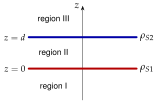
Superposition of two sheets, each with the field of Problem 3.2.3. Keep track of the signs region by region: a sheet's field points away from it if .
Each sheet alone produces the field of Problem 3.2.3, of magnitude , directed away from the sheet when (towards it when ). By superposition, adding the components in each region:
For (a capacitor) the field is (along ) between the sheets and zero outside, as in Problem 3.2.4. For the field is zero between the sheets and outside, pointing away from the pair (for ). Figure 3.2.28 compares the two cases.
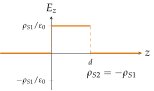
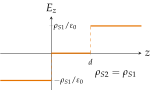
In every case the field jumps by across each sheet, as Gauss's law applied to a thin pillbox requires: