Section 3.2 · Further exercises · 8 of 10
Exercise 3.2.8: Flux through the faces of a cube
About the further exercises of Section 3.2
Ten further exercises in the spirit of Problems 3.2.1–3.2.5 and the home exercises. All of them use Gauss's law in its integral or differential form,
together with symmetry and, where useful, superposition. Exercises 3.2.1–3.2.2 have cylindrical symmetry, Exercises 3.2.3–3.2.4 planar symmetry, and Exercises 3.2.5–3.2.9 spherical symmetry (or a symmetry argument of another kind), while Exercise 3.2.10 checks the law for a field without any symmetry.
Flux through the faces of a cube
#cf. the picture of Gauss's law
A point charge is placed (a) at the centre of a cube, (b) at one of its corners. In each case find the flux of through each face of the cube.
Adapted from: B. M. Notaroš, Electromagnetics, Problem 1.51.
No integration is needed: Gauss's law gives the total flux through a closed surface around the charge, and symmetry tells us how it is shared between identical faces. For the corner, build a larger cube around the charge out of eight copies.
The cube encloses , so by Gauss's law the total outward flux is . The six faces are identical as seen from the charge, so by symmetry each receives the same share:
Imagine eight identical cubes sharing the corner where sits (Figure 3.2.31). Together they form a cube of twice the side with at its centre, and the total flux out of it is . By symmetry each small cube carries out through its three faces that do not touch the charge, and these three faces share it equally. On the three faces that meet at the charge, is parallel to the face (it is radial from a point lying in the plane of the face), so the flux through them is zero:
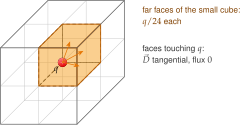
The total flux through the cube in (b) is , not : a charge on the boundary of a surface is not "inside" it, and the symmetry argument shows exactly how much of its flux the surface catches. Equivalently, the cube fills one octant of the space around its corner, and so catches one eighth of the flux.