Section 3.2 · Worked examples · 2 of 2
Worked example 3.2.2: Charge inside a conducting shell
About the worked examples of Section 3.2
Two short calculations tied to the applications. Each one is Gauss's law plus one symmetry argument, and nothing else is needed. The numerical constants used are , Eq. (1.4.2), , and . A good way to use them: read the given quantities, choose the Gaussian surface and write yourself, and only then put the numbers in.
Charge inside a conducting shell
#cf. Application 3.2.1
Given. A point charge is at the centre of an uncharged, isolated conducting spherical shell with inner radius and outer radius .
Find. (a) the charge and on each face of the shell, (b) just inside , in the metal, just outside and at , and (c) what changes if the shell is earthed.
Adapted from: D. K. Cheng, Field and Wave Electromagnetics, 2nd ed., Example 3-11.
Use concentric Gaussian spheres (Figure 3.2.33). Inside the metal , so a Gaussian sphere drawn in the metal encloses zero total charge, which determines the charge on the inner face. The neutrality of the shell then fixes the charge on the outer face. By symmetry both face charges are uniformly distributed.
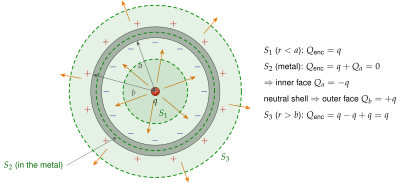
On a sphere inside the metal, , so : the inner face carries . The shell is neutral, so the outer face carries . Spread uniformly,
for , in the metal, and for . With :
Check: , in agreement with at the inner face (where the normal pointing out of the metal is ).
Earthing removes the from the outer face: then for all , while nothing changes inside (the inner face still carries and the field for is unchanged).
Outside, the shell reveals only the total charge: the same outer field results whether is at the centre or off-centre (the outer face charge stays uniform, and only the inner face charge rearranges). Earthed, the shell hides even that: the charge in the cavity is completely screened from the outside, the Faraday cage working in reverse.
Change , the net charge of the shell and its earthing below, and drag the Gaussian sphere through the regions: vanishes in the metal, and outside only the total enclosed charge counts.