Section 3.2 · Topic 5 of 7
3.2.5 Applications of Gauss's law
Gauss's law is used in two ways in practice. The first is to compute the field of a symmetric source in a few lines (Problems 3.2.1–3.2.5). The second, together with the fact that the electric field vanishes inside a conductor in electrostatic equilibrium, is to say where the charge on a conductor sits and what the conductor shields. The two applications of this section use these ideas:
- Faraday cage: no field inside a closed conductor (shielded rooms, cable screens, the car in a thunderstorm).
- Coaxial cable: between the conductors, nothing outside, and the field peaks at the inner conductor.
Three basic results about conductors
A conductor contains charges that are free to move: the conduction electrons of a metal. When a conductor is placed in a field or given a charge, these free charges move until they reach a configuration in which no force acts on them any more. This state, reached in a very short time, is electrostatic equilibrium. Three results follow, the last two from Gauss's law.
-
(i) inside the conducting material. If there were a field, the free charges would feel the force and would still be moving, contrary to the assumption of equilibrium. Figure 3.2.11 shows how this comes about: the free charges pile up on the surfaces until their own field cancels the applied one inside the metal.
-
(ii) Any net charge resides on the surface. Since , hence , at every point inside the material, there. Equivalently, a Gaussian surface drawn anywhere inside the metal, however close to the outer surface, has zero flux and encloses zero net charge. Excess charge can only sit on the surface, as a surface charge density .
-
(iii) Just outside, is normal to the surface and . A tangential component of at the surface would drive the surface charges along the surface, so in equilibrium the field just outside is normal to it. Now take a small pillbox of face area straddling the surface, one face inside the metal and the other just outside (Figure 3.2.12), and let its height shrink to zero. The inner face has and the side contributes nothing in the limit, so only the outer face counts:
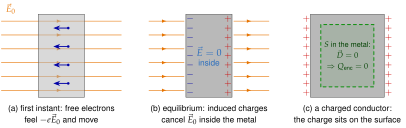
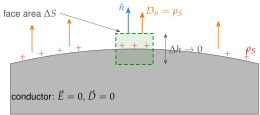
In a conductor the charges are free, so they keep moving until they feel no force: no field inside, all excess charge on the skin, and just outside a field that stands perpendicular to the surface with strength .
is placed on a solid copper sphere. Where is the charge, and what is at the centre?
All sit on the outer surface (spread uniformly, by symmetry), and everywhere in the copper, including the centre.
In a conductor in equilibrium the free charges move until everywhere in the metal, otherwise they would still be moving. M. Faraday showed experimentally in 1836 that a closed conducting shell therefore screens static fields completely from its interior.
When an external field is switched on (Figure 3.2.13), the free charges move and pile up on the outer faces of the shell, negative on the side the field comes from and positive on the other side, until their own field cancels everywhere inside the metal. Now apply Gauss's law on a closed surface drawn inside the metal and surrounding the cavity. On we have , so
if the cavity contains no charge, the total charge on the cavity wall is zero. In fact the wall carries no charge at all and the field in the empty cavity vanishes identically (see the box below). Whatever happens outside, a sensitive circuit inside the cage feels no static field. Figure 3.2.14 shows the computed field lines around a long conducting tube placed across a uniform field: the lines bend so as to meet the metal at right angles, end on the induced charges, and not a single line enters.
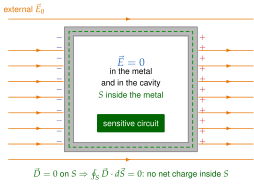
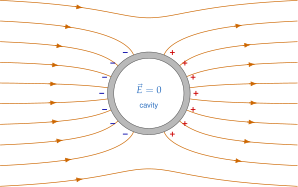
Gauss's law on only says that the total charge on the cavity wall is zero. Could there be positive and negative patches on the wall, adding up to zero? A field line from a positive to a negative patch would run through the cavity from the conductor back to the same conductor. Section 3.3 will show that a conductor in equilibrium is an equipotential and that the potential always falls along a field line, so such a line is impossible. Hence the wall carries no charge anywhere and the empty cavity is free of field.
The shield need not be a solid sheet. For time-varying fields, which go beyond electrostatics, a mesh also shields provided its holes are much smaller than the wavelength. The door of a microwave oven is the standard example: at the free-space wavelength is about , while the holes of the metal mesh are a few millimetres across. Screened rooms for electromagnetic-compatibility (EMC) testing and for magnetic resonance imaging (MRI), and the braided outer conductor of a coaxial cable, work on the same principle.
A car struck by lightning largely protects its occupants because the current and charge stay on the outer metal body, the cage, and do not enter the interior. A mobile phone often loses its signal in a metal lift for the same reason: the metal box screens the incoming radio waves.
The cage shields the cavity from charges outside. If a charge is placed inside the cavity, there is a field in the cavity: the lines of run to the induced charge on the cavity wall (Worked example 3.2.2). It is the metal in which , always.
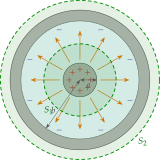
The coaxial line, patented by O. Heaviside in 1880, is Problems 3.2.1 and 3.2.2 made into a product. It consists of an inner conductor of radius and a coaxial outer conductor, the screen, whose inner surface has radius . The space between them is filled with an insulator (air in what follows). In normal operation the inner conductor carries per metre and the screen per metre (Figure 3.2.15). Three Gaussian cylinders tell us everything:
-
() encloses only the charge of the inner conductor, , so exactly as in Problem 3.2.1
The field is largest at the inner conductor, , which is where the insulation is most stressed and where breakdown starts.
-
A Gaussian cylinder drawn inside the metal of the screen has on it, so it encloses zero charge: the inner face of the screen carries exactly per metre. The surface charge densities are on the inner conductor and on the inner face of the screen. Both agree with .
-
() encloses : the outer face of the screen carries no charge and outside. The field is confined to the insulator between the conductors: nothing leaks out, and (by Application 3.2.1) external static fields do not reach the signal.
If the screen were isolated and neutral, Gauss's law in its metal would still put on its inner face, but neutrality would then put on its outer face and the cable would have the external field of a line charge. This is one reason why the screen is earthed: the outer charge flows away to earth (Worked example 3.2.1).
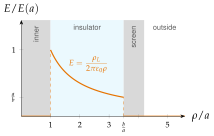
Worked example 3.2.1 puts numbers in: for , and the field is at the inner conductor and at the screen, and since air breaks down at about an air-spaced line of these dimensions can carry at most about .
Solve the cross-section of a coaxial line numerically below: the potential and the field lines show the field confined between the conductors and crowding at the inner one.
Antenna feeders, oscilloscope probes, cable television and the old 10BASE2 Ethernet on RG-58 cable. Filled with gas, the same geometry is the proportional counter and the Geiger–Müller tube of radiation detectors: the electron avalanche develops in the strong field close to the thin central wire.
The screen of a coaxial cable is earthed and the inner conductor carries . What is outside the cable?
Zero. A Gaussian cylinder in the screen metal forces onto the inner face of the screen, and earthing removes any charge from the outer face. A cylinder outside the cable then encloses .
Table 3.2.2. The applications of Gauss's law in this section.
| Application | Physics used | Worked out in |
|---|---|---|
| Faraday cage | in the conductor, for the cavity | Worked example 3.2.2 |
| Coaxial cable | cylindrical symmetry, | Problems 3.2.1–3.2.2, Worked example 3.2.1 |