Section 3.2 · Topic 4 of 7
3.2.4 Gaussian surfaces
Gauss's law holds for every closed surface and every charge distribution, but as a tool for calculating fields it is useful only in special situations. The integral involves the unknown field under an integral sign, and in general one number (the flux) cannot determine a whole vector function. What helps is symmetry.
Gauss's law is especially powerful whenever you can construct a surface enclosing the source on which the electric field is constant and parallel to the surface's normal unit vector.
Such a surface is called a Gaussian surface. Parts of it on which the field is perpendicular to the normal are also allowed, since they contribute nothing (Figure 3.2.3). On the Gaussian surface,
and the magnitude follows by a single division.
The three Gaussian surfaces
Three symmetries allow such a surface to be constructed in practice. They are collected in Table 3.2.1 and illustrated in Figure 3.2.10, where the parts of each surface that carry flux are shaded orange and the parts that carry none are grey.
Table 3.2.1. Choosing the Gaussian surface: the symmetries for which Gauss's law determines the field.
| Symmetry | System | Gaussian surface | Parts with | Flux |
|---|---|---|---|---|
| Planar | infinite plane (sheet, slab) | pillbox across the plane | the two faces (area each), side gives | |
| Cylindrical | infinite rod (line, cylinder) | coaxial cylinder | the side, caps give | |
| Spherical | sphere, spherical shell | concentric sphere | everywhere |
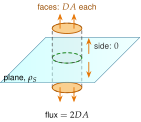
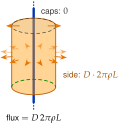
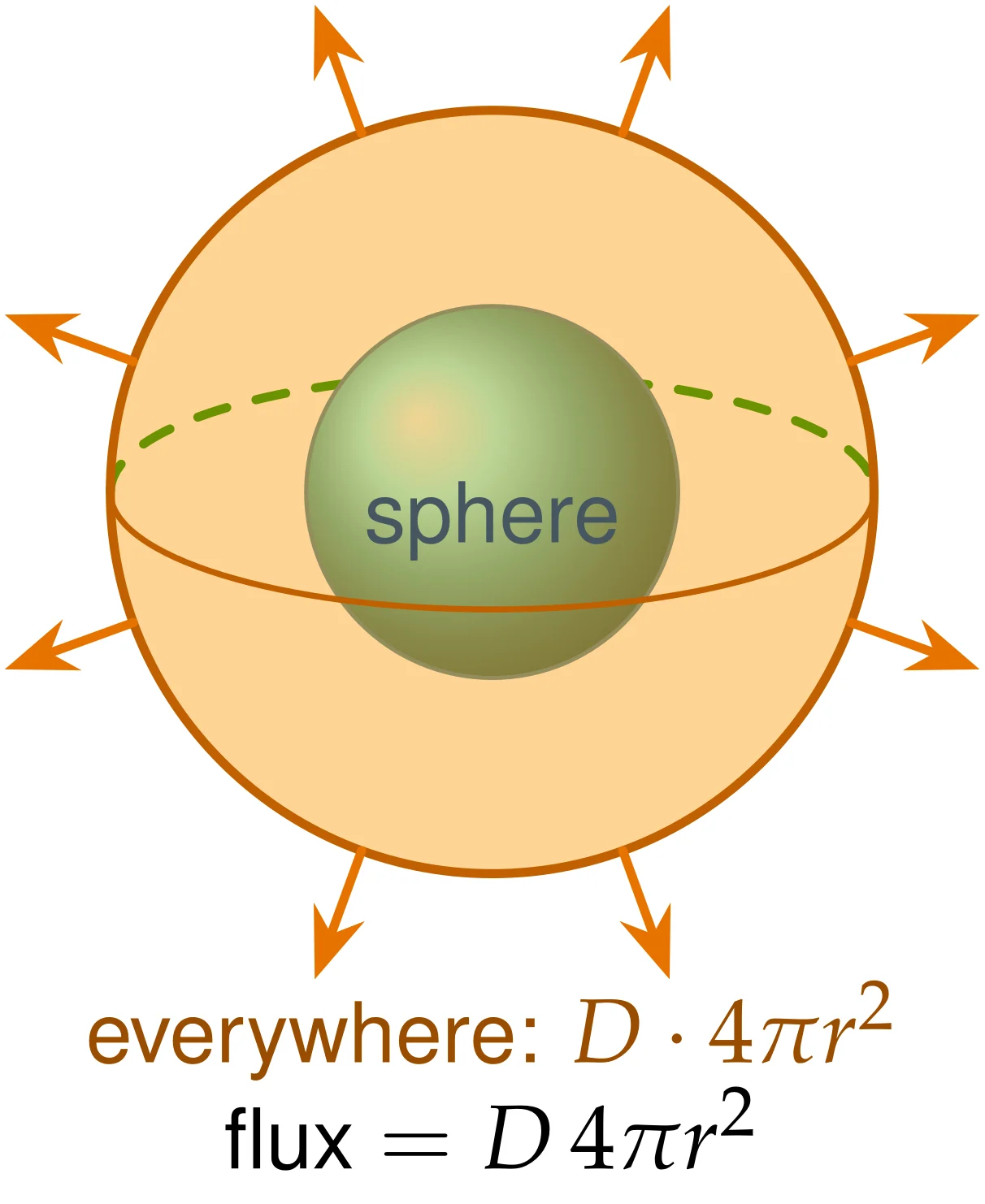
The procedure is always the same, and it is worth following it step by step in every problem.
- Symmetry. Find the operations (translations, rotations, reflections) that leave the charge distribution unchanged. They must leave unchanged too, which fixes the direction of and the coordinates it can depend on.
- Surface. Choose a closed surface through the field point P whose parts are either perpendicular to (with constant on them) or parallel to (Table 3.2.1).
- Left-hand side. Evaluate the flux part by part. It reduces to times an area. Do not forget any part (caps, second face).
- Right-hand side. Compute the charge enclosed by the surface (only the part of the distribution inside it).
- Solve for , then in free space. Check the units and the limiting cases.
Using a cube around a point charge, or a sphere that is not centred on it, and then writing . Gauss's law still holds on such a surface (the flux is ), but varies over it, so cannot be taken out of the integral and the field cannot be extracted. Choose the surface after the symmetry argument, so that it matches the symmetry.
For a pillbox across a charged sheet, both faces carry flux. Writing only one face, , gives , twice the correct field of Problem 3.2.3. (One face is correctly dropped only when it lies inside a conductor, where , as in Problem 3.2.4.) Conversely, the caps of a coaxial cylinder must be checked, not ignored: they give zero because there.
Gauss's law always holds, but it is only useful for computing when symmetry makes constant (or zero) on the parts of a surface. A finite line charge, a disk or a dipole have too little symmetry: their fields must be found by the integrations of Section 3.1. For such fields Gauss's law can still be checked, as Exercise 3.2.10 does for a field without any symmetry.
Could Gauss's law be used to find the field on the axis of a uniformly charged finite disk?
No. The law holds, but no closed surface exists on which the disk's field is constant and normal (or tangential): the field changes in direction and magnitude from point to point. The axial field was found by integration in Section 3.1 (Problem 3.1.3).
Problems 3.2.1–3.2.5 at the end of the section carry out this programme for an infinite line charge, a cylindrical surface charge, an infinite plane, a pair of conducting plates and a spherical shell. The results are used throughout the applications that follow.