Section 3.2 · Problems · 4 of 5
Problem 3.2.4: Two parallel conducting plates
Two parallel conducting plates
#Find the electric field between the two conducting plates in the figure. The plate at carries and the plate at carries on their facing surfaces.
Adapted from: B. M. Notaroš, Electromagnetics, Problem 1.60.
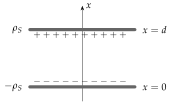

Two routes give the same answer: superpose the fields of two charged sheets (Problem 3.2.3), or use Gauss's law with a pillbox that has one face inside a plate, where because the plates are conductors. Comparing them is instructive.
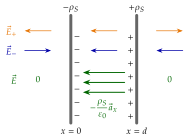
Each charged surface alone produces the field of Problem 3.2.3, of magnitude , pointing away from and towards (Figure 3.2.20a):
- the sheet at gives for and for , and
- the sheet at gives for and for .
For both contributions point in the direction and add. For and they are opposite and cancel:
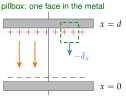
The same result follows directly from the fact that the plates are conductors. Take a small pillbox of face area across the lower surface of the upper plate (Figure 3.2.20b), with one face inside the metal, where in electrostatic equilibrium, and the other face in the gap, whose outward normal is . The side contributes nothing (the field in the gap is normal to the plates), and only the gap face counts:
so that , as above. A pillbox with one face in the metal of the lower plate gives the same value, and a pillbox with one face in the metal and the other outside the pair encloses no charge (the outer faces are uncharged), so the field outside vanishes.
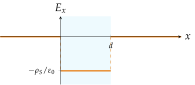
Both routes agree, and the field points from the positive plate () to the negative plate (), i.e. along , as it should. The second route shows a general rule: just outside any conductor the normal component of equals the local surface charge density, (Section 3.2.5). The field between the plates is uniform as long as is small compared with the plate dimensions (fringing at the edges neglected). This is the parallel-plate capacitor of Section 3.4.
Model the two plates by four sheets (two faces each) and require the field to vanish inside both metals. Each sheet contributes at every point. Writing the condition for a point inside each plate gives two equations whose solution forces the two outer faces to carry equal densities, whose sum is the total charge of the pair, here zero. Hence the outer faces are uncharged and all the charge sits on the facing surfaces.