Section 3.2 · Home exercises · 3 of 3
Home exercise 3.2.3: Uniformly charged cylinder
Uniformly charged cylinder
#By using Gauss's law, find the electric field inside and outside an infinitely long solid cylinder of radius carrying a uniform volume charge density . Compare the field outside with Problems 3.2.1 and 3.2.2.
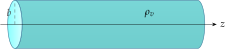
Cylindrical symmetry and a coaxial Gaussian cylinder (Problem 3.2.1). Inside, the cylinder encloses a solid cylinder of radius , and outside, the whole cross-section.
The cylinder has the symmetry of Problem 3.2.1, so . For the left-hand side we take a coaxial cylindrical surface of radius from to . As in Problem 3.2.1,
The Gaussian cylinder encloses a solid cylinder of radius and length :
and equating both sides, :
The Gaussian cylinder encloses the whole cross-section :
which gives
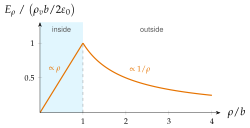
Change the radius and the charge density below: the field rises linearly inside and falls as outside, like that of a line charge.
Outside, the cylinder acts like a line charge on its axis (Problem 3.2.1), just as the hollow cylinder of Problem 3.2.2 did with : only the charge per unit length matters outside. Inside, the field grows linearly from zero on the axis (Figure 3.2.25), like the field inside the uniformly charged sphere, , but with instead of . Both expressions give at : no surface charge, no jump.