Section 3.2 · Problems · 2 of 5
Problem 3.2.2: Cylindrical surface charge
Cylindrical surface charge
#Find the electric field inside and outside of a cylindrical surface charge with a radius of and a uniform surface charge density of by using Gauss's law.
Source: B. M. Notaroš, Electromagnetics, Problem 1.57.
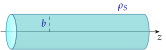
Same symmetry as the line of Problem 3.2.1, so the same Gaussian cylinder works, once inside and once outside the charged surface. The flux has the same form in both cases, and only the enclosed charge differs.
The charged cylinder has the same symmetries as the line of Problem 3.2.1: translations along , rotations about , and the two reflections. Exactly as there,
both inside and outside the cylinder.
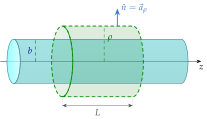
We take a cylindrical surface of radius , coaxial with the charged cylinder, from to , once with and once with (Figure 3.2.17). On its side and , while the caps contribute nothing. As in Problem 3.2.1,
Both cylinders have the same flux formula. Only the enclosed charge differs.
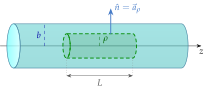
The Gaussian cylinder lies entirely inside the charged surface and encloses no charge,
which gives , that is
Physically, at a point inside, the contributions of the charge on the near side and on the far side of the shell cancel exactly.
The Gaussian cylinder encloses the whole charge on a length of the charged cylinder, whose area is :
Equating both sides,
Again has cancelled, and for we find
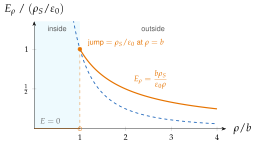
Units: is . Outside, the charged cylinder is indistinguishable from a line charge on its axis (Problem 3.2.1): only the charge per unit length matters. At the field jumps from to (Figure 3.2.18). This is true at any charged surface, as a thin pillbox straddling the surface shows: the jump in the normal component of equals .